

Trump swaps Susie for Stephen
How will Donald Trump approach his final two years in office after being comprehensively rejected in the midterms? Double down.
Despite recently saying there was ‘zero chance’ that his chief of staff Susie Wiles was on the way out, he just confirmed she is leaving her position and is being replaced by Stephen Miller. Wiles was the White House’s first woman CoS and joins a long line of women who have left Trump’s side this term, either by being fired or quitting. Wiles has been a fascinating character in the second Trump Administration, and was seen as a calming and organised presence.
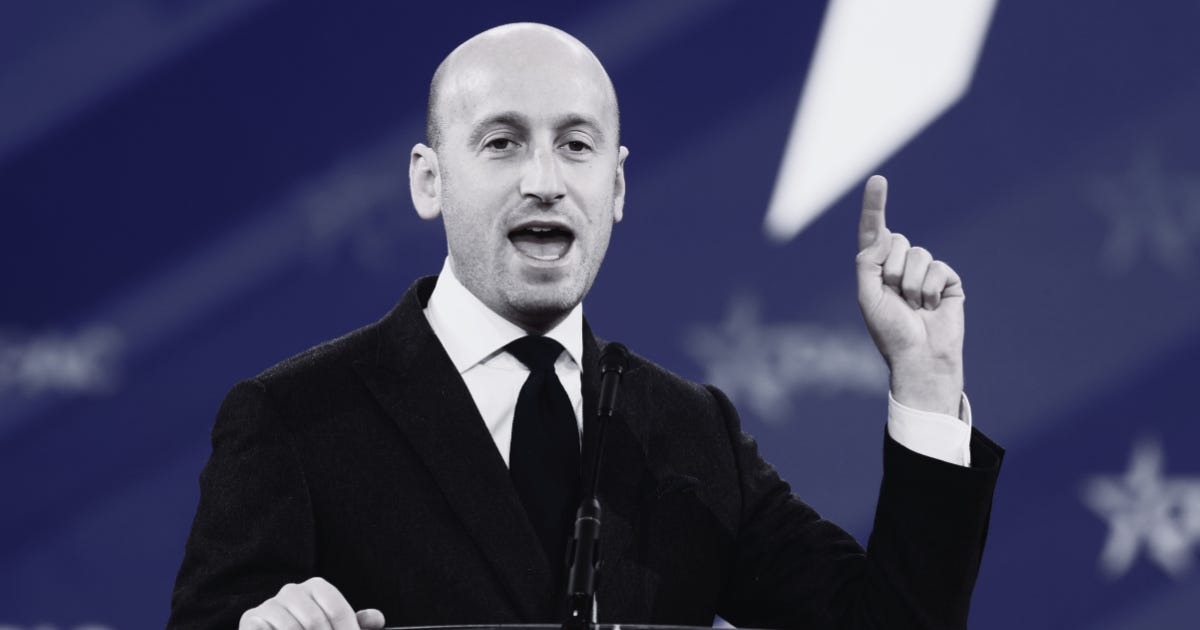
By contrast, her deputy, Miller, is the architect of the MAGA approach to government, and is the guy who began the whole ‘let’s suggest invading Greenland’ idea and is associated. He is associated with the crueller elements and message of Trump’s White House.
It is little surprise that Trump’s reaction to being so overwhelmingly rejected at the ballot box this week is to embrace his chief pugilist. What really matters is whether Miller will be brought to heel by the Republicans now out to reclaim their movement or they remain feckless.
‘Stephen’s been great, and sometimes in life, you gotta make moves,’ Trump told reporters shortly after announcing the staffing shakeup.
‘Stephen’s been with me from the beginning. He gets it, very good politically, and he’s a very good man,’ he added.
Wiles submitted her resignation on Thursday evening, two sources familiar with the matter said, and the president announced that the move would take effect Monday.
Trump, who initially appeared unfazed by the results of the Tuesday night midterms, has become angrier as he’s watched coverage of the historic losses, according to the people familiar with his response. That sour mood has spread throughout the West Wing, which has become increasingly factionalised in recent days.
Trump made his displeasure with his political team known starting at a tense election night reception in the East Room, according to one of the people familiar with the matter. He vented that deep Republican losses were the result of their strategy. Wiles was among those Trump blamed for the Republican losses, the person said.
As it became clear that the president was unhappy with her, Wiles decided to resign, believing he should be able to tap someone to lead his White House that had his confidence, according to a person familiar with her thinking. That person noted that Wiles had a tough year personally, given her cancer diagnosis and treatment, saying: ‘It wasn’t worth her staying in a job Trump was making clear he didn’t want her in.’
Since the midterms wipeout, Trump had heard from several allies and associates who urged him to make changes to his senior staff in response to the losses, arguing that there needed to be a change in approach inside the West Wing, a source familiar with the matter said. But the move nonetheless came as a shock to many in the administration, and multiple White House officials told CNN it left them concerned about the rest of Trump’s second term.
‘Susie keeps the trains running on time. I don’t know what this looks like moving forward,’ one official said.
Miller a wrecking ball
Miller was a central character in Regime Change, which Michael Warren picked up in this remarkably prescient post at the time.

Miller, much like Trump himself, crashes through roadblocks and hurdles, paying no heed to the rules—not the rules of government, and not the rules of collegiality. He’s less of a mastermind and more of a bully, less a crafty strategist and more an unstoppable blunt force. His methods recall the children’s book about a family going on a bear hunt and facing various obstacles along the path. We can’t go over it. We can’t go under it. We’ve got to go through it!
That gets Miller what he wants, but only to a point, and often at great long-term cost to the cause of Trumpism. A strategy of fear, intimidation, and a refusal to ask permission can mow down quite a bit of opposition, but when Miller runs up against more immutable barriers, such as federal judges or public outrage, he finds a way to slink out the back and let someone else take the blame. Miller’s posture is to be all-powerful, and, failing that, fade into the wallpaper. In this way, he is a purer, more refined version of the man to whom he has dedicated the past decade of his professional life.
…
One of the central themes of the book is that, unlike in the first term, Trump has a better understanding of where his own powers have no or only weak limitations, and he is exploiting that knowledge to do more of what he wants. Unencumbered by the sort of internal guardrails that sometimes fenced him in, Trump is taking bigger swings, acting even more on gut and instinct. The same appears to be true, only more so, with Miller.
But if Trump and Miller were different men—less monomaniacal, more methodical, more introspective about what stymied them during the first term—this blow-by-blow account of the first 18 months or so of Trump 2.0 might be a happier story from their perspective. As it stands, the president’s approval rating is hovering just under a dismal 40 per cent. His efforts to dramatically force his will through executive actions are frequently thwarted by the federal judiciary, including the Supreme Court. His party risks losing its majorities in this fall’s midterm elections thanks in large part to his attention to pet obsessions like tariffs and a war with Iran at the expense of the pocketbook concerns of inflation he ran on.
The Trump-Miller approach of taking a wrecking ball to our civic infrastructure rather than trying to co-opt or outsmart the opposition may have successfully destroyed much of what has so infuriated the MAGA populists about Washington. But there’s been practically no permanent reconstruction atop the rubble, no lasting new edifices on which Trump will be able to credibly slap his name, no lasting legacy of what Trump’s governance has wrought.
If this is how the Trump era ends, the things that the president so loves about his most intense aide—what Haberman and Swan describe as Stephen Miller’s ‘bulldog mentality, his instinct to turn the dial up on controversy, and his way of framing issues and acting on them with blunt, Godfather-inflected language’ —will have been a big part of why the Trump project failed to deliver on its promise for a new golden era.
Tariffs, not just Iran, killed Trump
We have now entered one of my favourite parts of the political cycle, the post-election blame game.

Vice President JD Vance, ever the opportunist, wrote a lengthy X statement blaming the Iran war (which the media reported he did not support) and partly supporting Israel the day after the results were in.
His positioning is always the frame for his ambition. Before the midterms, the jockeying for the 2028 nomination was centred on who was the purest MAGA of all. Now I think it is questionable whether MAGA even survives. But if it does, Vance will want to wear that crown.
Which is why his rapid attempt to apportion the blame to Iran is convenient: the MAGA base hates Forever Wars, and this was a key promise of the movement and Trump’s pitch for the Presidency again.
But this excellent piece in the conservative National Review says not so fast.
The story of the initial collapse of the Trump administration must — no matter how much some may approve of the policy — therefore be a story about a broad tariff regime instituted with imperial arbitrariness and open abuse of constitutional powers, not one of the Iran war. Our misbegotten Middle Eastern adventure in March 2026 is only where the bottom truly dropped out, the breaking point where Senate seats like South Carolina and Mississippi finally came onto the board. But there is much more to it than that.
The administration was underwater and had been rejected by the voters long before then, and one of the most important (and least discussed) reasons was that Americans of all stripes have become disgusted with the naked, celebratorily selfish corruption that Trump and his administration have come to be synonymous with. A full 90 per cent of voters in exit polls cited ‘corruption’ as one of their crucial voting issues — and they weren’t thinking about Somalians in Minnesota.
…
It’s the inescapable omnipresence of Trump’s corruption — the way it governs his view of the world, infects his underlings, informs the way he conducts foreign policy even — that has fatally inured his MAGA followers to the effect it has had on everyone else. While it may be the tariff regime and the Iran war that ultimately brought Trump down, what made it impossible for him to recover was the in-your-face, omnipresent stench of his corruption
Divided Democrats cannot waste their chance
With the rush of the results over, there is a growing narrative, dare we say, uneasiness about how the Democrats execute and wield their mandate ahead of the 2028 presidential election.

Noah Smith has an excellent piece breaking down the factions inside the Democratic Party and illustrates their challenge.
If Democrats are going to translate midterm success into presidential victory — to say nothing of long-term partisan dominance — they’re going to have to work hard at rebuilding their brand, their sales pitch, and their policy platform after the disastrous years of 2016-2024.
…
One important point, which a lot of other people have already made, is that the big Democratic wave was mostly won by moderate Democrats.
…
The normie uprising has brought center-left Dems to the fore, and it has also forced more progressive Dems to tone down or strategically compromise their more extreme positions.
But moderation itself is neither an ideology nor a policy program, and herein lies the big challenge for the Dems over the next year and a half or so.
…
Right now, my assessment is that most Democratic voters — including Independents and swing voters who lean toward the Dems — aren’t thinking very hard about how the country ought to be governed or what the future of America should look like. They’re simply thinking short-term thoughts about the immediate threat. They hate Trump and MAGA, and they want them gone, and it’s really as simple as that.
…
There’s also the more pragmatic question of what Dems should actually do over the next two years, while they hold Congress but not the presidency. This is an inherently difficult problem, because Trump can just veto almost any legislation the Dems pass. The usual tactic here is to just obstruct anything the president wants to do, hoping that making the president’s term in office look like a failure will help the opposition in the next election.
But I believe Democrats can do better than this. First of all they can, and should, investigate Trump and his family and friends for corruption. Corruption turned out to be a huge issue in these midterms — even more important than I realised it would be.
…
What they can also do is to workshop their economic policy program under low-stakes conditions. America has two big economic challenges looming — the out-of-control national debt, and AI. Dems can start demonstrating — and at the same time, start figuring out — how they’d address both of these challenges if they had the presidency.

America is still Great
For me, the standout theme of this result has been the utter repudiation by the American people of Trump’s trashing of their national values. It is heartening to see so many exit polls factor corruption and standards so high amongst Americans’ priorities.

We are always told Americans don’t vote on foreign policy and that Trump’s shocking threats to invade Greenland, trash allied war dead and betray Ukraine for Russia would have been lesser issues on their mind, if at all. But this result says that is not true. America’s greatness has always been its attempts to combine its superpower role with values of better: freedom, democracy, rule of law. Otherwise, it is no different to China and Russia. I’ve spent a lot of time on my podcast asking any American who has been generous enough to grant me their time some of these questions, and I know the next time I run into them, they will be thrilled to be able to tell me that the answer is in once and for all.
I don’t for a second think that the fractures and challenges to the Alliances are going to be suddenly fixed, and quite honestly, nor should we want a snap back to where we were; we all need to grow up and be more capable. But for those who questioned the value of the alliance, I think it is safe to say that we talk about being ‘like-minded’; we can put ourselves in the same category as the American people with certainty.
For Republican candidates and campaigners this cycle, cruelty became almost a central campaign tactic. Many of them struggled to mount a serious policy case, and found themselves stuck with a historically unpopular president as party leader, so they fell back on the tried-and-true manoeuvre of beating up on the weak, hoping it would work as well as it seemed to throughout the Trump era.
Yet on Tuesday night, voters delivered a verdict: They were fed up with that cruelty in both the administration and Republican campaigns. Instead, decency — or, at least, voters’ impression of it — won.
…
Joe Walsh, the former GOP member of Congress and current anti-Trump activist, told me.
‘Republicans tried to win again this year by being as cruel and fearful and divisive as they could. That’s generally worked in the past, but there were extenuating circumstances this year,’ Walsh said. ‘People [on the trail] would tell me, ”This is not the kind of country we are. This is not who we are.” ‘They were referring, he said, to masked ICE agents, the targeting of Black and brown people, and talk of white Christian nationalism.
‘There was something more profound at stake here,’ Walsh continued. ‘And I think it was the American people recoiling against the cruelty they’ve seen.’
And that’s my list for this week.
Please do send me anything that’s caught your eye; I enjoy knowing what you’ve been reading.
🇳🇱 This week I have been in The Hague in the Netherlands attending the Inter-Parliamentary Alliance on China’s annual conference where I moderated a panel with three former defence ministers, Gen Nakatani of Japan, Ruben Brekelmans of the Netherlands and Dovile Sakaliene of Lithuania.


🛫 🇯🇵 Next week I am heading to Japan to attend the Japan Foundation’s Nara MIRAI Forum on Advancing the Evolution of a ‘Free and Open Indo-Pacific’.
🎙️ On the ABC’s Global Roaming, Geraldine Doogue and I discussed the looming South African elections with John McDermott, chief Africa correspondent for The Economist and Laura Tingle and I interviewed Brazilian-born Associate Professor Deborah Barros Leal Farias about Lula’s extraordinary comeback in the Brazilian elections.