

Regime Change
This is the book everyone seems to be reading right now. Australian-born Jonathan Swan and his New York Times veteran colleague Maggie Haberman have written a thrilling account of Donald Trump’s first years back in the White House.
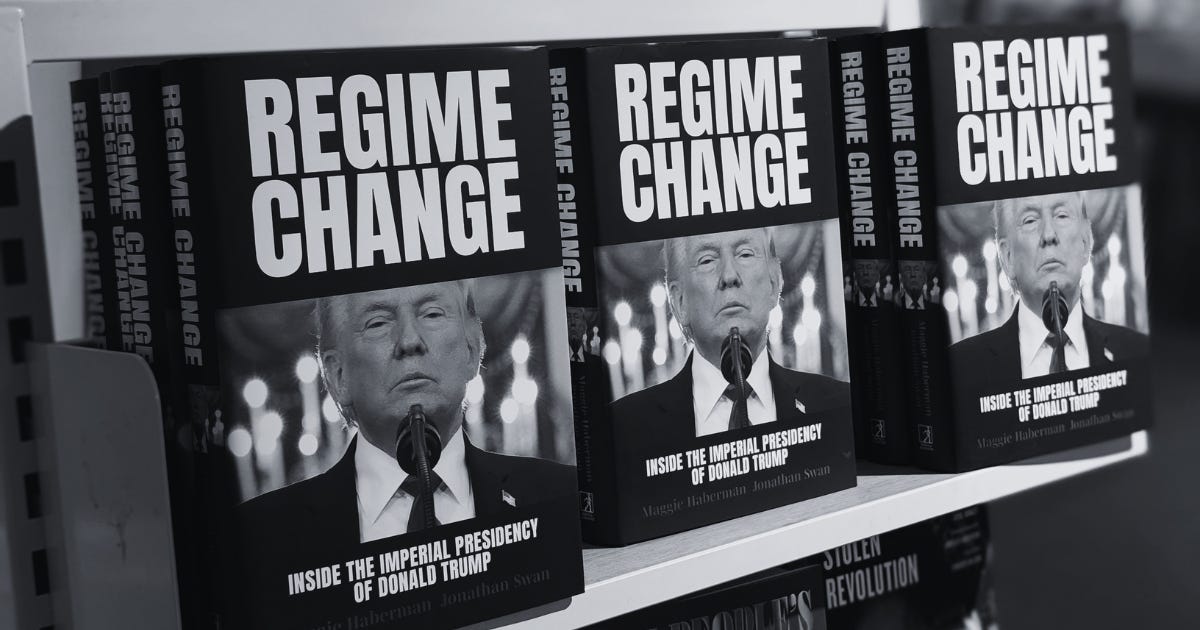
While it is a ripping and well-written read, full of descriptive references to what the weather felt like on any given day — a nod to Australian journalist and political writer of the same genre Pam Williams, who helped out with the edit — this is not a book packed with consequential revelations. It is actually a terrific recap of all the events of the first two years, particularly if you’ve struggled to keep up with the sheer volume and pace of the Trump Administration 2.0.
Think of it more as a beach read, as it is very fun, interesting and detailed chronicle and a total page-turner. I bought it on Monday and was finished by Friday during a busyish week.
Its strength is its fly-on-the-wall observations. It will describe who sat in what order and next to who the Oval Office, and what day-to-day life is like around Trump. The most gawk-worthy of this is detailing Trump’s slobbish, hoarding and late-night behaviour as he sleeps little and feasts on Diet Cokes and fast food. Tillating but not exactly groundbreaking.
But you won’t be bored. One chapter on artificial intelligence recalls the AI bosses briefing Trump on the potential of the technology and converting him from disinterested to a zealot for US AI in a matter of minutes. It shows a lesser appreciated part of Trump — his endless curiosity and open-mindedness about issues and policy challenges.
My favourite insight related to Trump’s boyhood desire to be a Broadway actor, an ambition that was opposed by his father. This to me made a lot click about Trump — a frustrated would-be performer, he has turned US politics, the White House and indeed the whole world into his live-televised stage. It also explains his obsession with fame, inability to feel shame about the costs of pursuing it and his obsession with culture and cultural icons.
Policy-wise, the most important part is the section claiming that Trump’s view on Taiwan boiled down to ‘Why would I send American troops to fight a war over a tiny island that most Americans couldn’t locate on a map?’ This is per ‘those close to him’, which is one of the drawbacks of Regime Change, there are very few direct quotes throughout this book, despite the authors saying they fact-checked their book with Trump as well as interviewed him along with 1000 others.
This is not to say the book is flimsy; it is not. Trump has notably not disputed the contents of the book, underlining its accuracy. But it could also reflect how untroubled by anything written in it, as it is overweighted in the trivial that showcase the chaotic way Trump and his Administration operate, but does not threaten him by carrying any voices of weight offering contextual analysis, or forcefully prosecuted dissenting views. Where it does get close, it shines, such as the chapter on how Trump comes to impose his ‘Liberation Day’ tariffs, something Scott Bessent and Howard Lutnick unsuccessfully try to stop, fully cognisant of the madness of imposing tariffs on allies and the bogus way they were calculated.
This shows the challenge of attempting to document the Presidency with Trump’s culture of fear and intimidation regarding public communication, resulting in self-censorship across Washington DC. Any truthbombs or reveals may have to wait until he has departed stage left.
This tension is most obvious in the chapter detailing Trump’s desire to go to war with Iran.
The president then turned to General Caine. ‘General, what do you think?’
General Caine replied: ‘Sir, this is, in my experience, standard operating procedure for the Israelis. They oversell, and their plans are not always well-developed. They know they need us, and that’s why they’re hard-selling.’
Trump quickly weighed the assessment. Regime change, he said, would be ‘their problem.’ It was unclear whether he was referring to the Israelis or the Iranian people. But the bottom line was that his decision on whether to go to war against Iran would not hinge on whether Parts 3 and 4 of Netanyahu’s presentation were achievable.
Trump appeared to remain very interested in accomplishing Parts 1 and 2: killing the ayatollah and Iran’s top leaders and dismantling the Iranian military.
General Caine — the man Trump liked to refer to as ‘Razin’ Caine’ — had impressed the president years earlier by telling him the Islamic State could be defeated far more quickly than others had projected. Trump rewarded that confidence by elevating the general, who had been an Air Force fighter pilot, to be his top military adviser. General Caine was not a political loyalist, and he had serious concerns about a war with Iran. But he was very cautious in the way he presented his views to the president.
As the small team of advisers who were looped into the plans deliberated over the following days, General Caine shared with Trump and others the alarming military assessment that a major campaign against Iran would drastically deplete stockpiles of American weaponry, including missile interceptors, whose supply had been strained after years of support for Ukraine and Israel. General Caine saw no clear path to quickly replenishing these stockpiles.
He also flagged the enormous difficulty of securing the Strait of Hormuz and the risks of Iran blocking it. Trump had dismissed that possibility on the assumption that the regime would capitulate before it came to that. The president appeared to think it would be a very quick war — an impression that had been reinforced by the tepid response to the U.S. bombing of Iran’s nuclear facilities in June.
General Caine’s role in the lead-up to the war captured a classic tension between military counsel and presidential decision-making. So persistent was the chairman in not taking a stand — repeating that it was not his role to tell the president what to do, but rather to present options along with potential risks and possible second- and third-order consequences — that he could appear to some of those listening to be arguing all sides of an issue simultaneously.
He would constantly ask, ‘And then what?’But Trump would often seem to hear only what he wanted to hear.
Federov says he was ousted for trying to reform corruption
It becomes a pattern that Volodymr Zelensky, faced with competent ministers, sacks them. To the outside world the Ukrainian President is a war hero, and a plucky leader that defiantly chose to stay and lead the fight against Russia’s illegal invasion. That is true.
But it is also true that he cannot handle rivals, and that people close to him, including his powerful former chief of staff, are being interrogated by corruption agencies, organisations he tried to nix last summer. That led to the first wartime protests against the leader, and he reversed course.
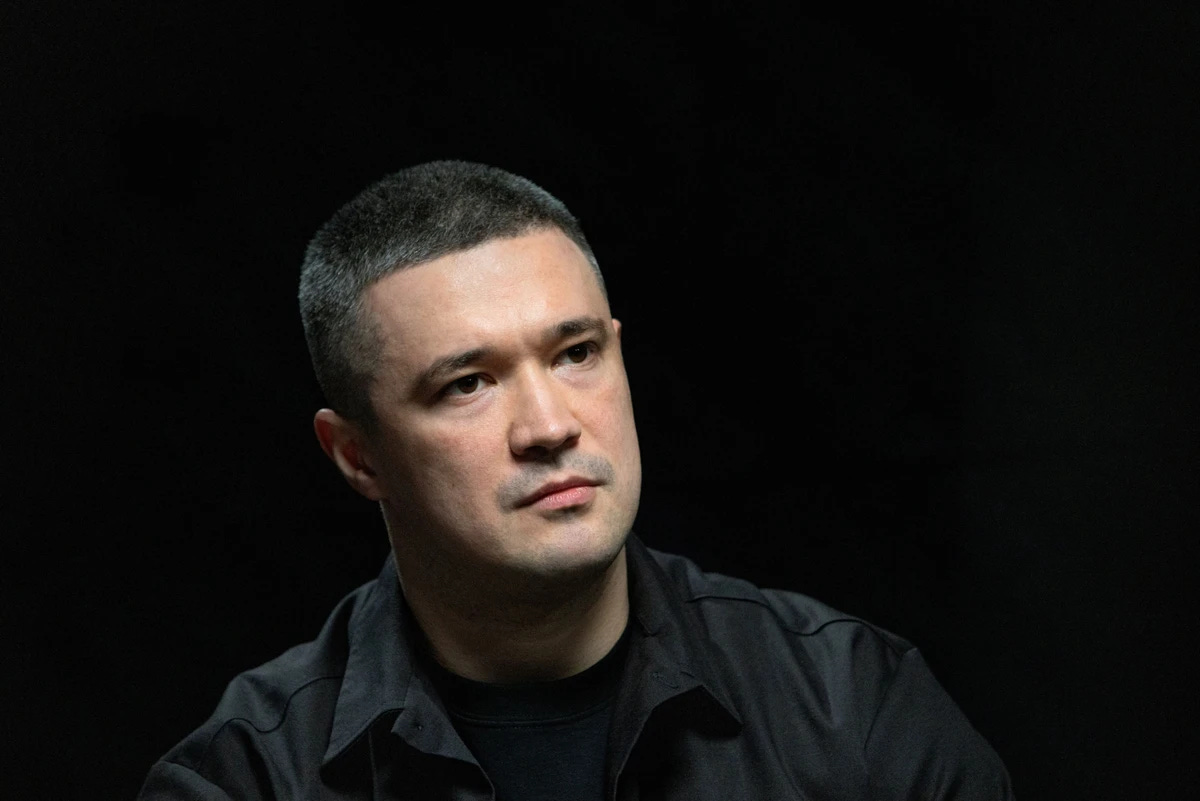
This year, Ukraine has been doing far better on the battlefield, due to the installation of Mykhailo Fedorov as Defence Minister. The 31-year-old began his career in social media but has turned his online geekery into transforming Ukraine’s digital infrastructure. He took this start-up approach to the Defence Ministry, only to be sacked, because of internal tensions that arose due to his reforming style.
Zelensky made probably the worst decision of his Presidency to date and sparked three straight weeks of new protests. Protests in Ukraine can topple Presidents and governments, so the voice of the people on the streets, particularly during wartime, is something to take seriously.
Zelensky has tried to fix the situation by installing a new General (the old one had clashed with Fedorov), but the people are still demanding Fedorov be reinstated and continued protesting in Kyiv overnight. Zelensky has possibly created a future Presidential rival with this insecurity, and if he doesn’t act soon, he will have his reputation internally tied to Ukraine’s corrupt culture, as opposed to the democratic and pro-European future the society has long yearned and indeed, is fighting and dying for.
Fedorov does not hold back about why he was sacked, and this interview will only further improve the public perception of him.
I spent seven years working in government, and I could never have imagined that there would be people in the Defence Ministry who were effectively appointed by private companies to head departments. Or that elements of the law enforcement system would have influence over certain processes. That gives you an idea of just how deeply entrenched the problem has become.
I was never fighting a particular person or group of people. Our focus has always been on building systems.
Our goal was to tackle the root of the problem as quickly as possible. First, to introduce competitive tenders. Second, to rebuild the management system within the Defence Ministry and recruit people differently, based on the objectives we set when we came into office.
I regarded pressure from various sides as simply part of the process. The priority was to rebuild the foundations, and once that was done, the problem would resolve itself.
What form did that pressure actually take? How did people try to stop your reforms, and who was behind it? Ukrainska Pravda sources in political circles say that David Arakhamiia, the leader of Servant of the People, the president’s parliamentary faction, actively represented the interests of certain weapons manufacturers.
I would rather not name specific individuals. There were no direct threats. Everyone knows me and knows where I stand on these issues. I think the fundamental problem is that far too many senior officials simply cannot imagine that someone could hold a high-ranking government position without having ties to the defence industry.
It is entirely possible to change the rules of the game, open up markets and help those markets develop without pursuing your own commercial interests within them. That problem of culture and values is influencing decision-making today.
Fedorov: “I was never fighting a particular person or group of people. Our focus has always been on building systems.”
…
But I warned the president back in April. I said: ‘Look, people are going to come and tell you that there’s something wrong with me, that I have political ambitions, that I own drone companies, that I’ve disrupted certain processes, and so on. You need to cross-check those claims with me, because I’ve trodden on the toes of a lot of people and companies. I need your support here.’
You can see that Ukraine’s largest Telegram channels were effectively bought, and they began working exclusively against me and my team. Criminal cases started to appear involving people who worked with me. The pressure ratcheted up month after month. And under that kind of pressure, it became increasingly difficult to continue implementing the reforms.
In the end, we saw where it led: to a government reshuffle, and today I am no longer in office.
India’s ‘cockroaches’ score rare win against Modi
India’s youth have begun a mass protest movement that has led to a rare show of humility from India’s strongman Prime Minister Narendra Modi.
This is an astonishing story. The movement began as a meme on Instagram and became a national movement in which Gen-Z protestors successfully forced the resignation of Modi’s Education Minister over exams that were leaked online, meaning millions of students would have to resit them.
This hit upon a raw nerve because of India’s youth unemployment problem and it’s university-educated youth who cannot find jobs to match their qualifications. When India’s Chief Justice of India Surya Kant called them cockroaches, an online movement was born. Boston University student Abhijeet Dipke created an Instagram account, a joke Cockroach Janta Party, which has amassed 27 million followers.
The movement that had followed has posed the most serious public challenge to Modi’s rule yet.
Modi had also lost another medium critical to the BJP’s domination over the national narrative – the mainstream TV news channels widely acknowledged to have been co-opted by the BJP government over the past 12 years and turned into mouthpieces for its rightwing Hindu nationalist ideology.
Initially, the channels ignored the protests, and when they did cover them it was to suggest the protesters were being bankrolled by sinister foreign forces and Pakistani terror groups. In response, the protesters turned on the channels, using social media to expose their ‘lies’. When the protests escalated, Modi remained conspicuously absent from the airwaves.
Pradhan’s resignation came as it appeared that all other options for the government had gone. The option of a ruthless crackdown appeared untenable given the mass outcry to the police violence that had hit protesters on Monday.
‘The online space was totally conquered by the protesters and regime-loving media was seriously delegitimised,’ said Ashutosh Varshney, a professor of international studies at Brown University in Rhode Island. ‘The anger was so comprehensive there was no option left but for Pradhan to go.’
But this was more than the loss of a minister, Varshney said, it was also the first time in 12 years that the Modi government had lost control of the political narrative. ‘This is a repressive government,’ he said. ‘It wants obedience, it wants no critical discussion and it generates fear. But now the climate of fear has collapsed.’
…
Prior to this week’s unrest, Modi had been riding high on a string of important state electoral victories, in particular the BJP’s first triumph in West Bengal, a politically important state that had long pushed back against its Hindu nationalist politics.
The BJP appeared to have fully bounced back from the blow in the 2024 elections, when the party failed to win an outright parliamentary majority and had to scramble together a large enough alliance to take power. At the same time, the much-beleaguered opposition had continued to lose countless state elections and their allegations of voting impropriety by the BJP fell mostly on deaf ears.
Yet the emergence of the cockroaches has reinvigorated not only India’s youth, but its political opposition parties as well. Jumping on the bandwagon, the opposition Congress party has had its best week in years as it mobilised protests and shut down parliament. The party’s leader, Rahul Gandhi, was dramatically dragged away by police outside Modi’s house in support of students.
Analysts say that dissent, which had been systematically crushed over the past 12 years, has now been re-galvanised as an effective tool to hold the government – and in particular the prime minister – to account.
‘After a long time, there’s an assertion of political agency across different sections of society,’ said Mehta. ‘And the minute you see that agency out in the street, it empowers lots of other agents.’
The Flamingo Revolution
Another protest to watch is the one taking place in Albania against Edi Rama. Rama was speaking on a panel at the Lennart Meri conference I attended earlier this year in Tallin, Estonia and gave one of the rudest performances I’ve ever seen from a world leader. I instantly wondered how his attitude is liked or not by voters at home.
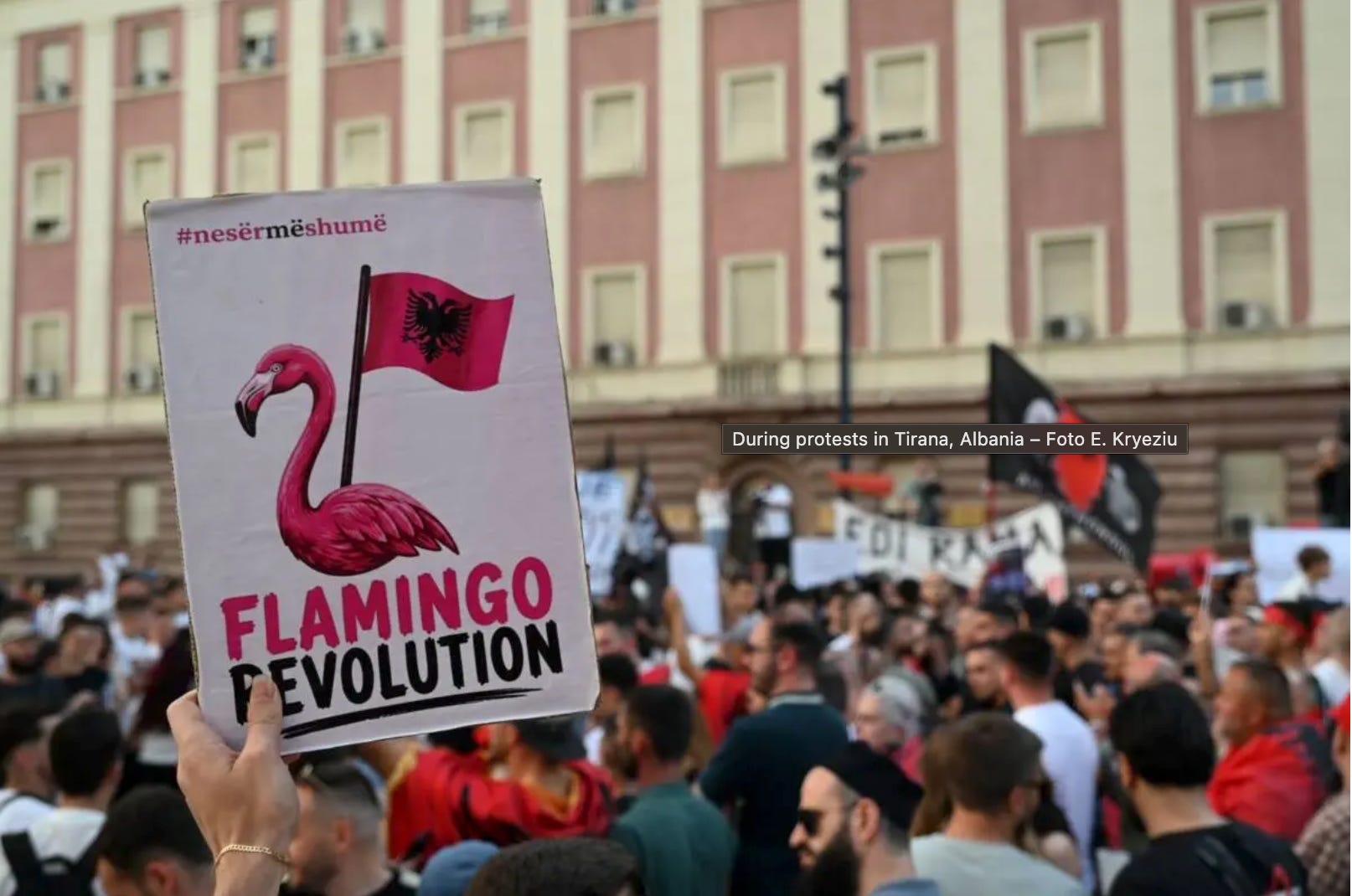
It turned out his behaviour is under intense scrutiny, domestically. It relates to approval given to Trump’s daughter and son-in-law, Ivanka Trump and Jared Kushner to develop an uninhabited but protected Albanian beachfront wetland reserve, home to thousands of flamingoes.
‘When the fences went up in early May, we could hardly believe it,’ said Kosta Xhaho, a physician and activist with Protection and Preservation of Natural Environment in Albania (PPNEA), Albania’s oldest environmental organisation, where he works primarily on the protection of marine biodiversity. ‘For a long time, we had publicly warned that something major was being prepared here, but we never thought they would cross the red line so suddenly.’ After secretive deliberations and business dealings, construction in the protected area began quietly almost overnight, in early May, when the tractors began levelling the sand dunes in the heart of the protected area, and workers laid the concrete posts that would later support the iron fencing used to cordon off the site.
It was PPNEA, together with a network of local activists and the efforts of Besjana Guri and her organisation Movement for Water, Environment and Integration (LUMI), that first drew public attention to what was happening in Vjosa-Narta, helping launch the mass protests.
And what began as an environmental campaign has evolved into a broader protest against Rama’s government, a movement that encapsulates years of accumulated frustration with a prime minister who has been in power since 2013.
Since May 30, thousands of people have gathered in Tirana every day at 6 p.m. to protest. Marching peacefully from Skanderbeg Square, the capital’s main plaza, to Rama’s office, demonstrators have formed a procession so long that in recent days it has stretched for half a mile along the Deshmoret e Kombit (Martyrs of the Nation) Boulevard.
…
The scale of corruption allegations surrounding Rama’s government is difficult to overstate. Over the past five years alone, several major scandals have implicated current or former members of his Cabinet.
Compulsory voting in the UK?
I cannot agree with former Australian Prime Minister Malcolm Turnbull enough on this issue; it is a travesty that things such as EU membership can be determined by only a select cohort of voters.
Our British friends would be well advised to adopt compulsory voting and preferential voting as well. I understand there is less support for adopting preferential voting since there was a plebiscite held on the question of what the Brits call “the alternative vote” and it was rejected.
But times have changed. In the UK today there are five major parties, from left to right they are: The Greens, Labour, Liberal Democrats, Conservatives and Reform. In addition there are a number of smaller parties and of course there are always independents including the now famous Count Binface.
With a first past the post system the winner is whoever has a plurality - more votes than any other candidate. With so many candidates and parties this will likely mean many constituencies will be won with pluralities below 40%, maybe below 30%. Couple that with low turnout and your electoral system is delegitimised
In Australia our major parties have seen their primary vote percentages drop down to the low thirties or lower, but because preferences are allocated in every electorate the winner will have more than half of the votes cast on a two party preferred basis. In other words the winner will have been elected by a majority of the voters, albeit for some of them the winner will not have been their first pick.

And that’s my list for this week.
Please do send me anything that’s caught your eye, I enjoy knowing what you’ve been reading.
On the ABC’s Global Roaming this week, Geraldine Doogue and I spoke to Michael Crick about the byelection in Nigel Farage’s seat of Clacton and the Reform UK Leader’s contest against Count Binface.
And Kylie Morris and I spoke to Cory Doctorow, who thinks the AI revolution is a financially inflated bubble that will burst.