

Fire and Fury
After recently reading Regime Change, I decided to go back to the definitive account of the first Trump term and re-read Michael Wolff’s deliciously gossipy account of the internal dysfunction that marked the first Donald era.
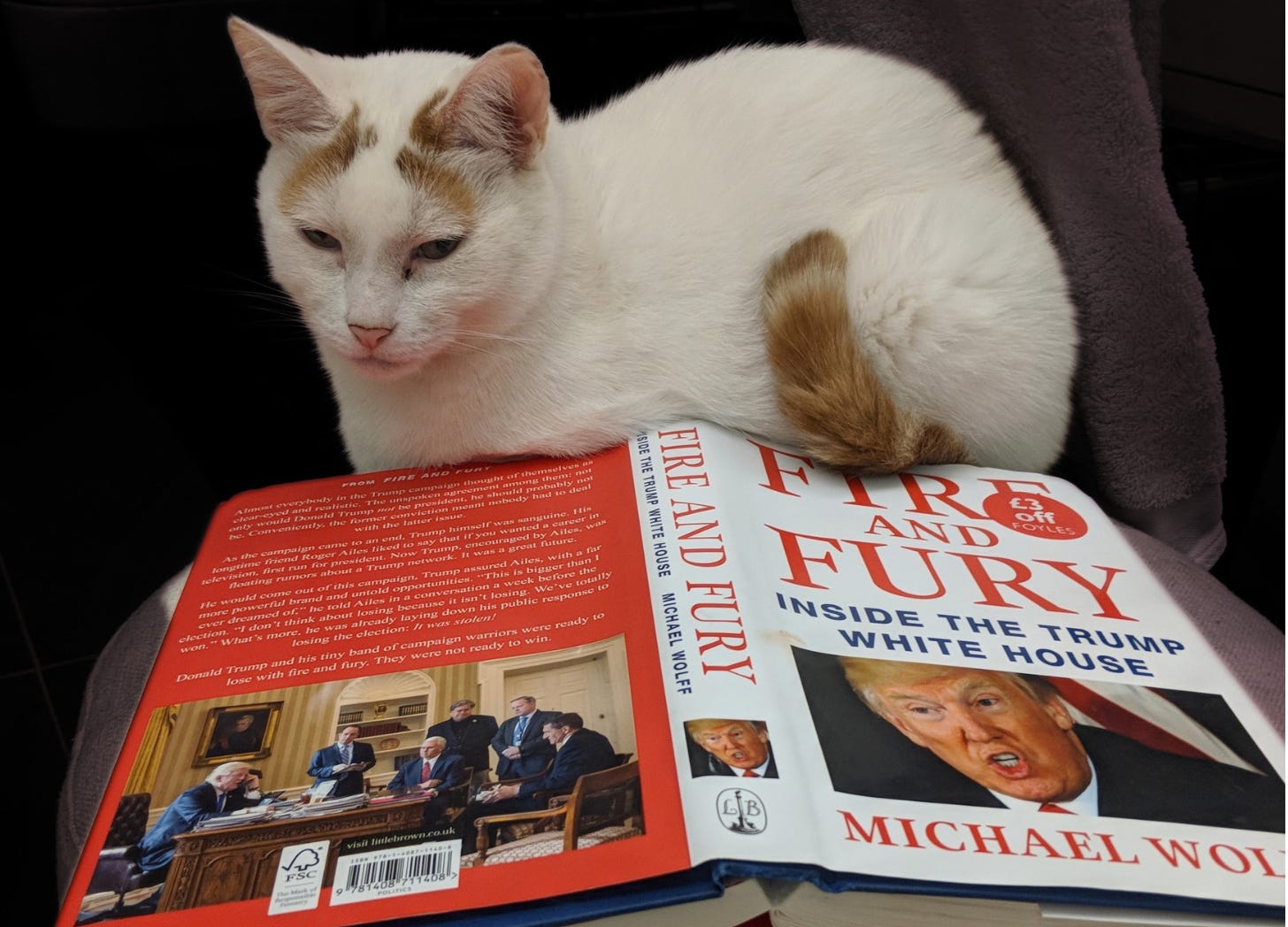
It was a worthwhile comparison read; much stood out, and it was also a helpful refresher.
While everyone remembers the high turnover of staff in the first Administration, I had almost forgotten the sheer chaos of the first Trump Administration that was centred around personnel, particularly the infighting, the wars between Steve Bannon and ‘Jarvanka’ — Trump’s daughter Ivanka Trump and her husband Jared Kushner.
Some might say Trump 2.0 is chaos on repeat. But it is different. While Regime Change illustrated how much policy was made up on the run, resulting in chaos, the lack of quotes attributed to key figures in the Administration, compared to Fire and Fury, when seemingly everyone was on the record in some way, underlined how disciplined, or silenced, Trump’s White House is the second time around.
Fire and Fury was not just policy chaos, but a chaos of clashing personalities, mixed with diametrically opposed views of how to execute whatever MAGA was back then.
Stephen Miller is just a backroom minion, but by the second term, an ideological driver bringing coherence to the MAGA agenda.
It was also interesting to review the role of Kushner, who is now leading the Board of Peace to try and bring peace to Gaza and compare how he, as family, eventually prevailed in the turf war with Bannon, who is no part of the second Trump term.
But Bannon’s legacy lives on. His strategy for communications is very much what Trump and the White House continue to deploy today and has arguably taken over many Western media ecosystems. It was fascinating to me that this was so clearly mapped out, yet still there seems to be little adaptation to mitigate the confected chaos and conflict from dominating the breakdown in political communication.
Bannon was rather a movie figure himself. A type. Alcohol. Bad marriages. Cash-strapped in a business where the measure of success is excesses of riches. Ever scheming. Ever disappointed.
Other than Trump himself, he was certainly the oldest inexperienced person ever to work in the White House.
One competitor in the conservative media business, while acknowledging his intelligence and the ambitiousness of his ideas, also noted, ‘He’s mean, dishonest, and incapable of caring about other people. His eyes dart around like he’s always looking for a weapon with which to bludgeon or gouge you.’
Bannon’s entire political career, such as it was, had been in political media. It was also in internet media — that is, media ruled by immediate response. The Breitbart formula was to so appal the liberals that the base was doubly satisfied, generating clicks in a ricochet of disgust and delight. You defined yourself by your enemy’s reaction. Conflict was the media bait — hence, now, the political chum. The new politics was not the art of the compromise but the art of conflict.
’Don’t sweat the small stuff,’ was a pretty good gist of Donald Trump’s — and Steve Bannon’s — world view. ‘Chaos was Steve’s strategy,’ Katie Walsh, former deputy chief of staff, said.
I’m not a monster presents… where is Austin Tice
So this is not strictly what I have been reading but more what I’ve been listening to (I can do you a list of my fav podcasts if there’s demand, just let me know FYI), but I have been glued to this podcast series from BBC investigative journalist Josh Baker and Sara Obeidat.
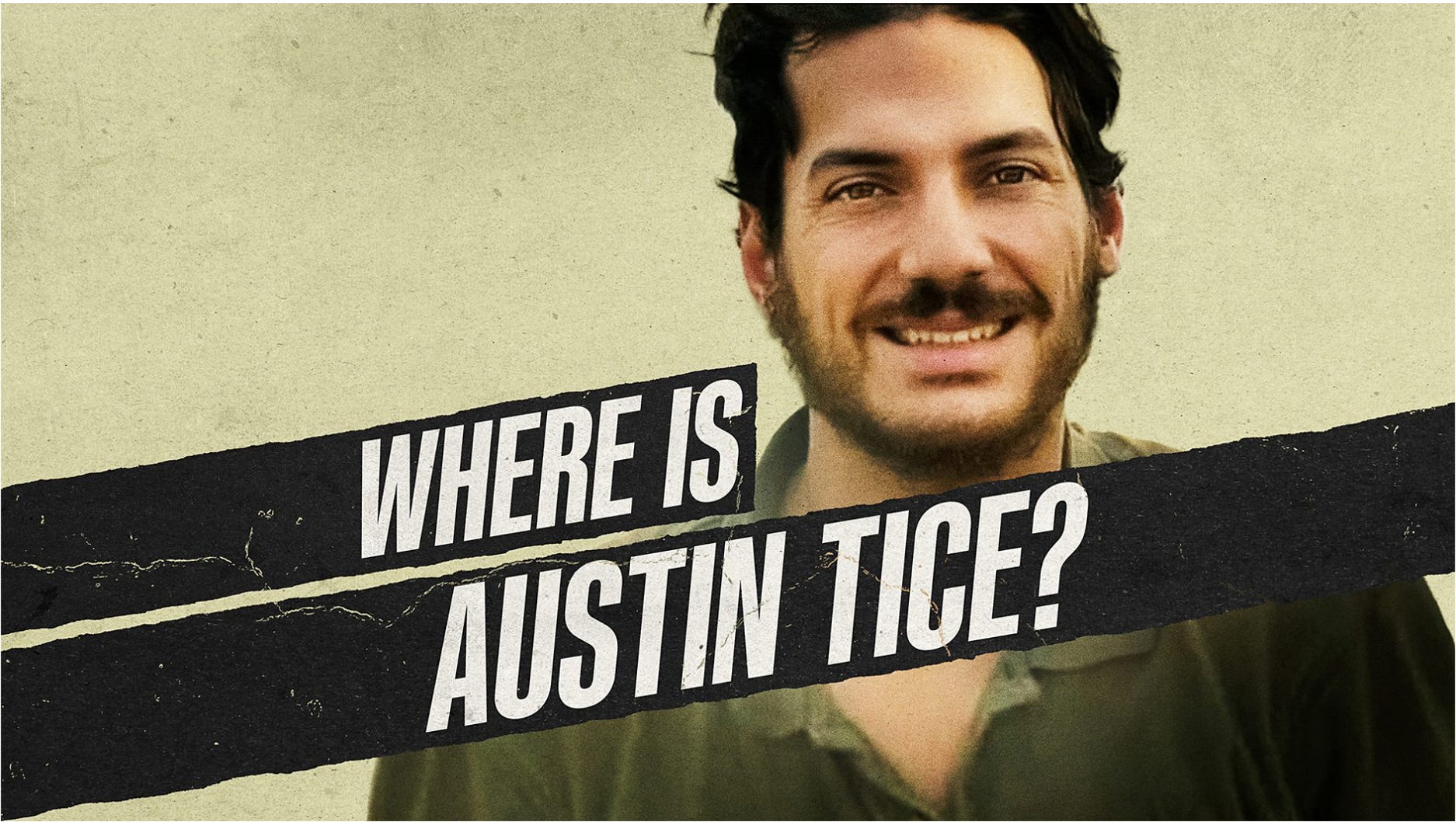
Baker’s second series, I’m not a Monster, explored the case of British ISIS bride Shamima Begum, which was also a sensation in both content and format. His audio storytelling is a sensation and just gets better and better.
This season goes on the hunt for Austin Tice in Syria, and some of the episodes, including finding a safe full of documents on Tice, are riveting, chilling and full of tension.
Baker’s curious, open mind, as well as his working relationship with Obeidat, shine in this series. It is a gripping story, told through facts and humanity, and I cannot recommend it more. They bring Syria and their hunt for Tice to life.
While Josh’s previous series explored questions of guilt and culpability, Where is Austin Tice? sets out on a different kind of mission: to unravel a real-life missing-person case.
Journalist Austin Tice disappeared in Syria more than a decade ago. Today, he is one of the biggest missing person cases of our time. Some accounts have placed him alive in a cell, others that he was smuggled out of Syria, and in the most tragic he died long ago. His mother Debra insists her son is alive and has led a tireless campaign to bring Austin home — a campaign that continues to this day.
What begins as an effort to help a mother find her son has become a multi-year investigation stretching from the corridors of power in Washington, D.C., to the depths of the Syrian security state. Josh travels to Damascus with Austin’s mother Debra, speaks to spies, tracks down alleged war criminals and reaches people who may know the truth about what happened to Austin.
Teaming up with investigative journalist Sara Obeidat, Josh retraces Austin’s journey and follows new evidence as it emerges, uncovering secret material and testimony that has already generated global headlines. And there is more to come.
The audience experiences the investigation as it unfolds — as witnesses are found, evidence arrives and the search moves closer to those who may know the truth.
Josh and Sara’s investigation begins before the fall of then Syrian President Bashar al-Assad, whose regime forcibly disappeared more than 100,000 people. The regime’s collapse changes everything. Intelligence facilities open, secret records are found and Syrians who survived the security state can share what they had seen.
Their testimony places Austin’s disappearance within a wider Syrian story: one of tens of thousands of families still searching for missing relatives, survivors seeking justice and a country confronting the legacy of fear and secrecy.
Trump ‘blackmails’ Europe
A lot gets said about ‘burden-sharing’ in the transatlantic relationship these days. But just which side is bearing the burden unevenly, or unfairly, these days?
After starting his war against Iran that he has so far been incapable of winning or ending, Trump has effectively blackmailed Europe into releasing 100 million barrels of diesel oil by the end of the year.
Trump had threatened Europe with an export ban to try and suppress domestic gas prices ahead of the November midterms.
Europe caved. An emergency (video) meeting of G7 leaders on Friday agreed to release 100 million barrels over the next four months.

European leaders are fuming.
One European diplomat characterised the White House’s demands for a release against the threat of a U.S. export ban explicitly as ‘blackmail,’ an official briefed on a call between EU energy officials early Friday told POLITICO.
‘EU member states took the US request as blackmail and see it as a broader security issue,’ the official said.
During that meeting, officials pondered how to appease President Donald Trump without appearing to cave to his threats, and others wondered whether the president could be relied upon not to ban diesel exports even if they did agree to his demands.
Indeed, European diplomats were privately furious at the White House request. Some European capitals — including Berlin — internally pushed back against the demand in emergency talks, saying that the Trump administration’s ultimatum was a ploy to help calm a US electorate angry about high energy prices ahead of the upcoming midterm elections. Trump has repeatedly said he was mulling an export ban to bring diesel prices down in the United States.
The arrangement also angered at least one European diesel trader.
‘So now they’re leaning on [the EU] to bail them out,’ the person said, ‘and they’re threatening the U.S. export ban to force them into doing so. Well, that’s called blackmail.’
Burnham may do big things
A great piece on Andy Burnham’s debut conference speech by Fleet Street Fox, aka Susie Boniface. She thinks his big agenda will grab voters, and is well overdue in Britain.
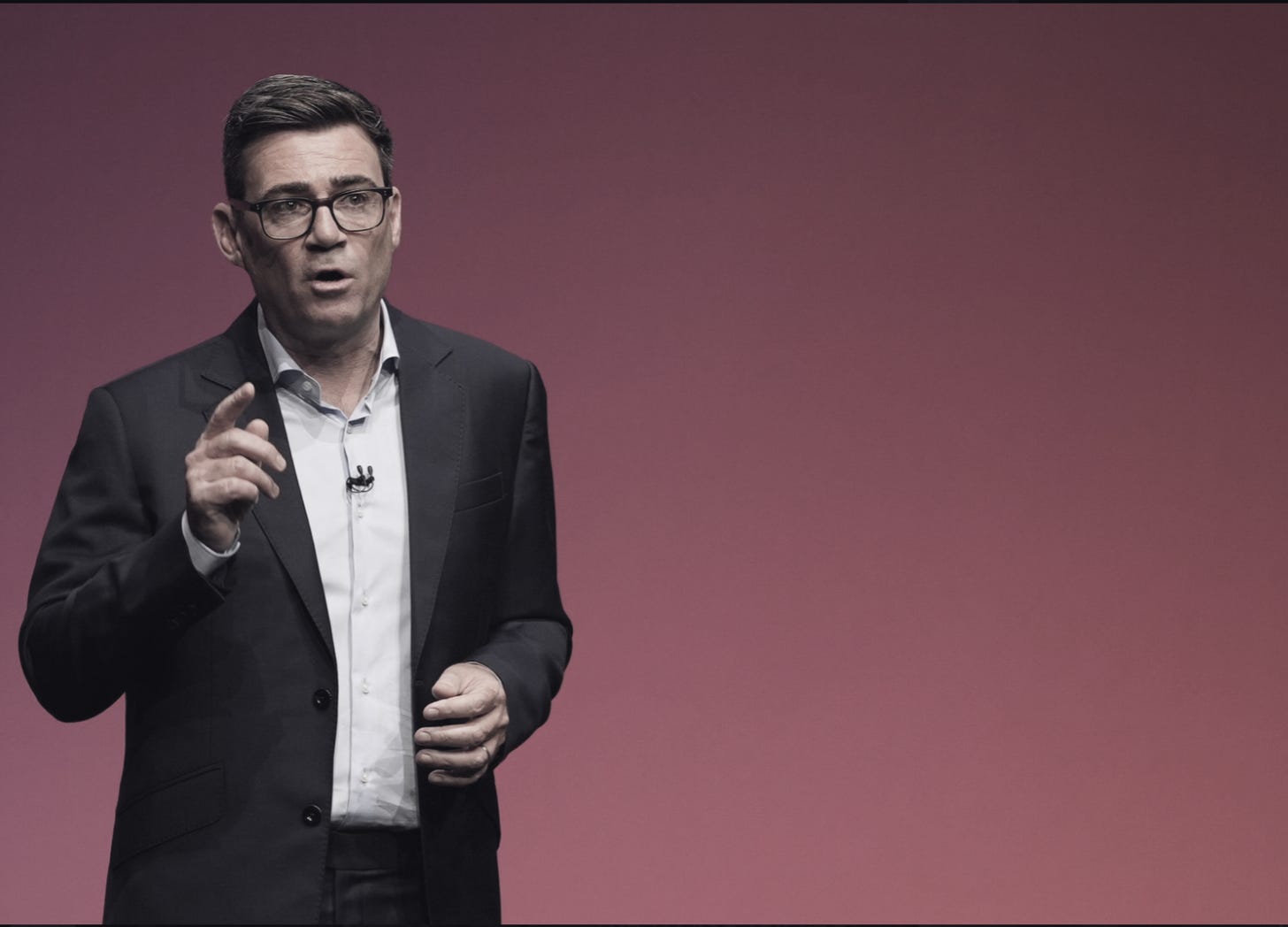
Burnham’s method is different. He’s planted his feet, stared at a far-distant horizon, and persuaded the political laws of nature to coalesce around him. Journalists like him because he just keeps making news. Voters like him because he’s different, with rock-solid certainty and a blueprint. He wants power as much the rest did, but he wants to use it for something big.
Suddenly that run at Makerfield looks less like opportunism and more like he just couldn’t wait any longer.
The argument about whether he’s right or wrong is yet to come, as is the bill, and the impact. But for once there is a Prime Minister who is talking about things he may never see come to fruition, things he thinks will be for the best, for everyone. It is the sort of vision that created the NHS after decades of dither, that built village schools or introduced universal suffrage. Few of us now can remember which party did what big things, or their reasons why. We just live in a country where everyone voting, everyone learning, and everyone getting to see a doctor (eventually), are such central tenets of existence that no politician would ever survive their abolition.
Andy Burnham might be the most expensive PM we’ve ever had. He might be the TikTokkiest. But regardless of how you vote and how long he has, I’ll bet my hat that he will do things that become the foundation of who we will be.

On Soho House
Full disclaimer: I’m a member. But this brutal takedown of the private members’ club franchise/chain, which has expanded far beyond what it should have, is utterly hilarious.

This is one article I absolutely stayed for the comments — laugh-out-loud funny.
Despite the resurgence of noughties nostalgia, Soho House remains, cataclysmically, the least cool space in London.
In fact, I’ve drawn up a shortlist of London’s least cool places to be seen: The Prince in West Brompton; any branch of Vagabond Wine; Polo in the Park; Frieze Art Fair; anywhere Steven Bartlett has visited in the last twelve months; and, in dead last, Soho House. It isn’t even close. Of course, Steven Bartlett may well have been to all of these places, in which case you must multiply their lameness by a factor of ten. Not double. Ten. That is how the Bartlettometer works.
Members’ clubs aren’t new. Groucho Marx famously said he wouldn’t join any club that would have him as a member. At the turn of the century, Soho House probably wouldn’t have had me either because I don’t work in a creative field. These days due to their mass expansion they’d welcome me and anyone with a couple of grand in disposable income with open arms. I have a Substack, and when your glittering membership list seems to be mainly recruitment consultants, lawyers and bankers, that probably makes me the most interesting person in the room. To them, I might as well be Byron. Although they’d probably think that’s a burger joint.
The real problem with Soho House is that once you lift up its skirt and get a glimpse of its knickers, there’s nothing much to get excited about. It’s like the first time you see someone naked. In your teenage mind the idea has been built up by anticipation, horny inventiveness and excited wonder. Then it happens, and you don’t know what to do with your hands. Soho House is a bit like that. I have no idea where I’m supposed to stand, or sit, or dance, or hold on to.
The sites they choose always seem weirdly random too. I imagine that the current target list for their next house might include a Prague brothel, a Balkan railway carriage, the Lubyanka, an Egyptian department store and Mar a Lago. Behind the big, imposing doors and the Gestapo check in girls, it’s all rather anodyne and unprepossessing. I’m not singling out any particular Soho House because, apart from the shell, they’re all finished in much the same way. The lighting is subfusc, the furnishings fusty, the ornaments faintly proctological, and a constant drone of oscitant conversation hangs in the air. They could only really be visually improved by a power cut.
And that’s my list for this week.
Please do send me anything that’s caught your eye; I enjoy knowing what you’ve been reading.
This week I returned home to London from New York, where I covered Australian Prime Minister Anthony Albanese’s visit to the United Nations General Assembly for The Nightly as well as to Apple HQ in San Jose, California. (So apologies for the lack of reading list last week; I could barely function last Friday from the exhaustion.)
📻 On the ABC’s Global Roaming, Geraldine Doogue and I interviewed Foreign Policy’s Ravi Agrawal on UNGA and Laura Tingle and I spoke to The Economist’s Tom Nuttall about Germany’s political situation.
Next week I will be in Venice moderating at the Italian Navy’s Trans-Regional Seapower Symposium.