

A Middle-Eastern, nuclear-armed NATO?
Saudi Arabia, Turkey and nuclear-armed Pakistan have signed a mutual defence pact, the Mecca Joint Defence Agreement, vowing to defend each other if one is attacked.
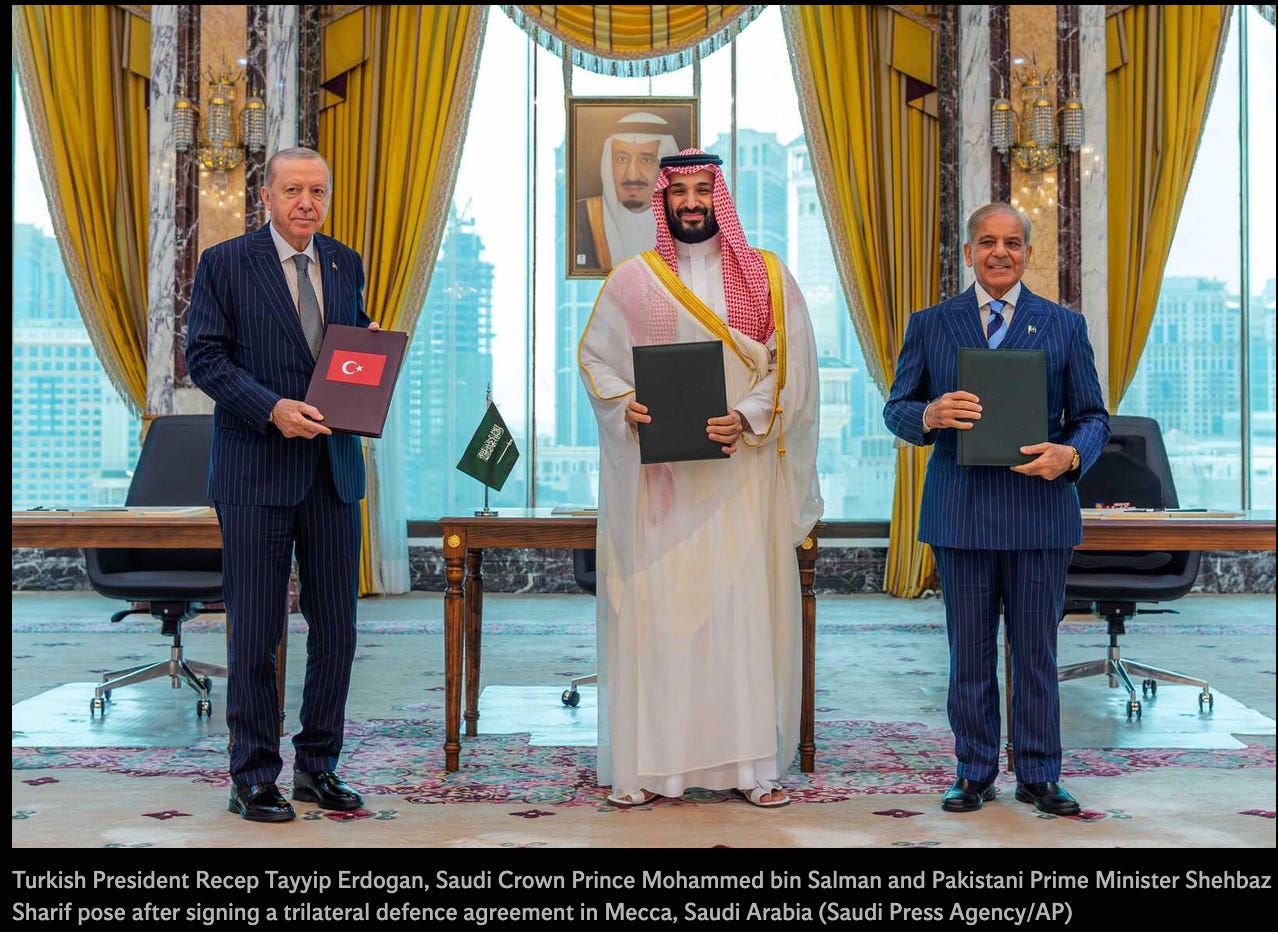
The landmark agreement signals distrust in the United States’ reliability, concern about an expansionist Israel and a desire in the region to look after their own security.
More countries, including Egypt, could join. But would this constitute a Muslim NATO?
Not quite yet. The countries are still to release the wording of their trilateral pact, which will ideally answer some ongoing questions about what it all means in practice.
Until the treaty text provides clear answers, describing the agreement as a Middle Eastern NATO is premature. It may prove to be an important strategic partnership, but partnerships and collective defence alliances are not the same thing.
That does not diminish its potential significance. Collectively, Saudi Arabia, Pakistan, and Turkey possess considerable strategic weight. Their combined economies approach $3 trillion, they occupy nearly four million square kilometres of strategically important territory, and together field around two million military personnel. Their forces reportedly include roughly 1000 fighter aircraft, thousands of tanks, tens of thousands of armoured vehicles, dozens of submarines, and hundreds of combat and naval platforms. Pakistan contributes a nuclear deterrent estimated at around 170 warheads, while Turkey’s NATO experience and expanding defence industry add another layer of capability. Saudi Arabia brings enormous financial resources and unmatched influence in global energy markets.
….
For Pakistan, another issue cannot be ignored. If Pakistan were involved in a future conflict with India, would Saudi Arabia or Turkey be expected to provide military assistance? Would their support be diplomatic, economic, intelligence-based, or operational? Conversely, would Pakistan be expected to come to Saudi Arabia’s defence in a Gulf conflict?
These are not hypothetical details buried in legal language. They are the very questions that distinguish a symbolic partnership from a genuine collective defence arrangement.
The timing of the Mecca Agreement is no coincidence. Around the world, middle powers are reassessing long-held security assumptions as global politics becomes more fragmented. Saudi Arabia has diversified its diplomatic partnerships well beyond Washington. Turkey has pursued a more independent foreign policy while remaining inside NATO. Pakistan continues to broaden its strategic options amid shifting regional dynamics.
Seen in that context, the agreement could become an important bridge linking the Gulf, South Asia, and Eurasia. Whether it develops into something more substantial will depend not on its symbolism but on the institutions built around it.
History offers a simple lesson: declarations are easy; alliances are difficult. They require shared strategic interests, clear obligations, institutional coordination, and political leaders willing to bear the costs of standing by their partners when crises erupt.
Putin could test NATO within next few years
The Wall Street Journal first reported a changed US intelligence assessment that Vladimir Putin could test NATO within a few years.

…the United States previously assumed that Putin would not wish to provoke a NATO member while still waging war against Ukraine. However, the newspaper quoted US officials as saying that the assessment changed this year.
The aim of a possible attack by Putin on a NATO country during the ongoing war in Ukraine would be to divide the alliance.
The newspaper also cited the deployment of soldiers in unmarked uniforms to occupy territories as a possible scenario.
China outrages, but Pacific remains divided
Another authoritarian power testing resolve is China.

Following it’s widely-condemed test of a nuclear-capable ballistic missile in the Pacific in July, the outrage across the Pacific was high.
But at a meeting of Pacific leaders, there was no consensus about how to phrase a statement criticising the weapons launch.
Pacific Islands Forum Secretary General Baron Waqa said China's missile test was discussed by ministers ‘at quite some length’. While everyone wanted a statement out, there were disagreements over what it should contain, he said.
‘There are mixed feelings on how the statement should be formatted, whether just to make an outright statement particularly on that single incident, but there are other ideas that it should be a general statement covering any tests in the Pacific,’ Waqa said at a media conference after the meeting.
New Zealand Foreign Minister Winston Peters told reporters that two members had refused to sign on to the statement, without giving a clear reason. He would not name the two countries.
…
China has expanded its influence in the Pacific in recent years through infrastructure financing, diplomatic outreach and security cooperation, which has prompted concern among traditional partners including Australia, New Zealand and the United States.
Peters said some countries were being influenced by those outside the region. He would not name the country he believed was influencing Pacific countries to not sign the statement.
Rudd on Xi
I’m a little late to this but I needed to catch the time to watch this properly. Former Australian Prime Minister and China scholar Kevin Rudd speaks to New York Times journalist Ezra Klein about Xi Jinping.
Rudd believes 2028 is the window of danger for the West, as Xi mulls whether the Trump Administration provides him with the best opportunity to attack Taiwan.
Every minute of this was fascinating. Come for the top line but stay for his rich insights, both as an academic and political and diplomatic practioner into China.
Rudd at his best.
Yes, I’m worried very much that Xi Jinping could miscalculate in 2028. Why I say 2028, by the way, and not 2027 or 2026, is that the Taiwanese have their own presidential elections in January 2028. And if the existing Democratic Progressive Party, which is anathema to Xi Jinping, gets re-elected, it will be for its fourth term, and it has run consistently on an independence-leaning platform. Will they get re-elected in January 2028? I don’t know, but I think it’s a 50-50 possibility.
Does this, therefore, become a trigger for Xi Jinping to say enough is enough? Open question — given he will have just been reappointed as general secretary of the party the previous October or November. And he’s aware that 2028 is a presidential election year here in the United States.
What do I fear? A miscalculation by Xi Jinping about the level of American resolve. Do the Chinese conclude post-Iran, for example, that the likelihood of any American leadership to deploy forces in the event of a Taiwan crisis would be reduced as a result of the Iran experience?
And then there’s the more mechanical question of the extent to which the American arsenal depth, magazine depth and capability set have been impaired as a result of Iran.
So my concern as an analyst is: Could he arrive at a conclusion through a bout of excessive self-confidence that a unique opportunity has arisen? The danger is that he actually miscalculates.
To act against Taiwan would be to cause President Trump to look weak. And the one thing I’ve observed about President Trump in the last several years I’ve been in Washington: The last thing President Trump likes is to look weak.
So I think we are in potentially dangerous territory.
Jesus Christ Superstar ⭐⭐⭐
I went to see Sam Ryder in Jesus Christ Superstar at the London Palladium this week.
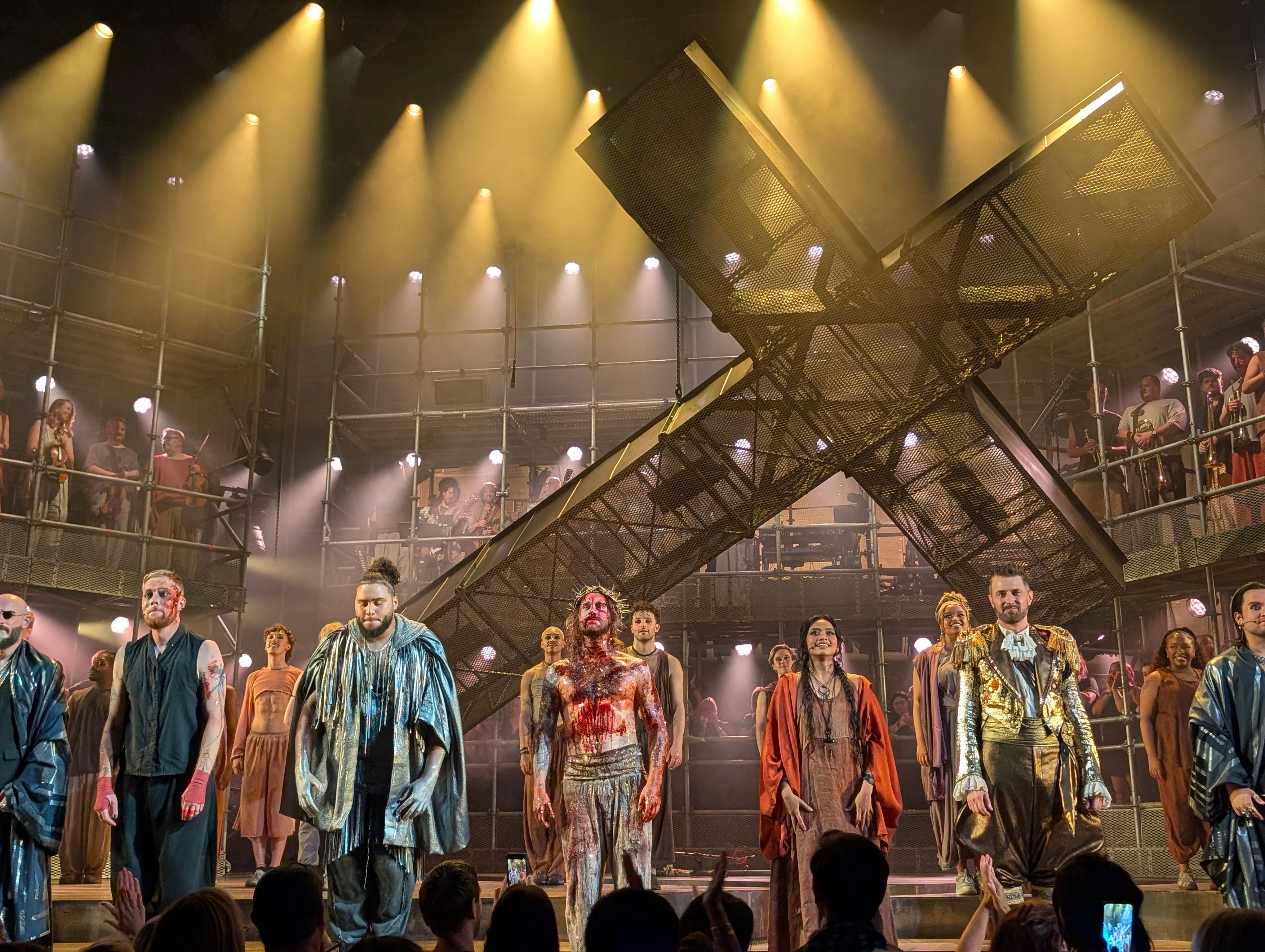
This is one of my favourite musicals, jam-packed with bangers. Andrew Lloyd Webber and Tim Rice’s other best creation (after Evita) stands the test of time.
While the interpretation was musically faithful, the production aimed for inventive but needed far more work to be as spectacular as it was striving for. The set is a scaffold set with audience participants watching on stage from behind the bars, adding to the sense of mob rule during the ‘Crucify him’ scenes. There is something terribly wrong with the sound production that I’ve never seen or experienced in the West End before. Too loud and overpowering, just about every vocalist is overpowered, and there were times when singing was peaking through the mics that made for some wince moments.
The bareness of the set means that those who have never seen this musical before will miss a lot, such as the temple scene where money is depicted as cups of glitter. It’s a nice touch, and glitter is used well in this production, but it does not set the scene whatsoever.
The musical moves fast and constantly, but the choreography jumps between high camp jazz hands and constant writhing that leaves the cast wriggling like half-dressed caterpillars. It underdoes the supremely talented ensemble and contradicts the tough, 80s-looking industrial set. The movement needed precision over fluidity to match the set.
There is, however, a magnificent cross that rises at the end and a really clever use of mic leads for the crucifixion that is paired with exquisite lighting that lends this show an immersive and intimate feel.
Ryder’s acting debut leaves much to be desired; he spends most of his time stumbling around the stage like a worried, befuddled, taller hobbit, complete with a man bun.
His singing is workmanlike until Gethsemene, when he absolutely brings it home, which is the only requirement of this role, really and deserves the standing ovation he receives. It was a genuine tear-jerker and better than most celebrity renditions out there.
Ryder is the name in lights, but there are many other, and better stars in this production.
Understudy Judas Billy Nevers was outstanding, although, like nearly every lead vocalist needed to enunciate his words. The other standouts were Bob Harms as the high priest Caiaphas and then there is the spellbinding Desmonda Cathabel as Mary Magadelene who may even be a purer West End vocalist than Lea Salonga.
While this is by no means a perfect production, I didn’t stop thinking about it for days which I think qualifies as passing the yes, go see it test. It transfers to Drury Lane in September. I recommend stalls for the full intimacy of this show.
The heavy rock instrumentation still manages to swallow up the sound design at times, meaning Tim Rice’s fast-paced, witty lyrics get lost.
About the performances: Sam Ryder in the title role - he is a famous pop star, and we understand that. We get plenty of his trademark vocal riffs and high notes, but the performance lacks the gritty emotional stakes and sharp dramatic focus that the role desperately requires. He is clearly still finding his footing with the specific acting demands of a major stage musical, especially in the quieter, reactive moments when he isn’t the central focus of the scene. That said, his vocal power is impressive, his popularity is undeniable, and hopefully he will settle into the dramatic side of things and improve as the run continues.
And that’s my list for this week.
Please do send me anything that’s caught your eye. I enjoy knowing what you’ve been reading.
🗳️ For my media, I joined Matt Chorley on BBC’s Radio Five Live to sing the praises of Australia’s compulsory voting system.
📻 On the ABC’s Global Roaming this week, Geraldine Doogue and I spoke to Simon Hill about FIFA boss Gianni Infantino’s attempt to sell off the Beautiful Game.
And Kylie Morris and I spoke to Daniel Trilling, who studies the far-right in the US, Europe and the UK.