China fires a nuclear-capable ballistic missile, NATO takes note
Australia personally thanked Mark Rutte for drawing attention to the Pacific
Ankara: For the second time in two years, China has tested a nuclear-capable missile in the Pacific.
The latest test was launched by a nuclear-powered submarine in the South Pacific and involved an intercontinental ballistic missile (ICBM) or nuclear-capable missile carrying a dummy warhead.
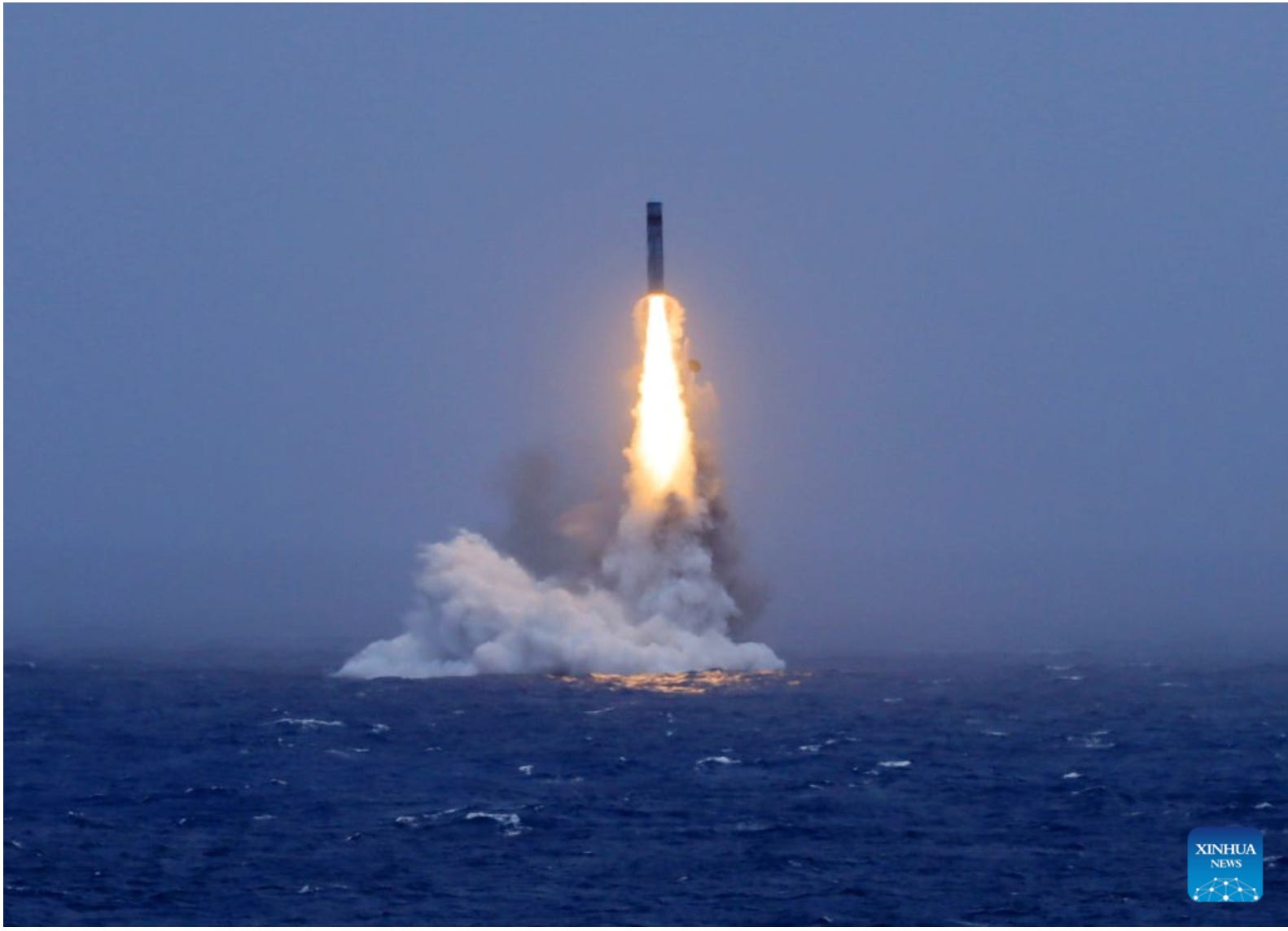
The test was confirmed on Monday by the Chinese propaganda outlet Xinhua.
‘The Chinese People's Liberation Army (PLA) Navy on Monday successfully conducted the test launch of a strategic missile by a submarine. The PLA Navy said that one strategic nuclear submarine of the navy successfully launched a strategic missile carrying a dummy warhead toward relevant high seas of the Pacific Ocean at 12:01 pm which landed precisely within the designated waters,’ the report said.
‘The test launch is a routine arrangement of the annual training of the PLA Navy, the navy said, adding that the Chinese side has already notified relevant countries in advance.’
Timing is a central theme of this latest test.
Xinhua’s use of the phrase ‘in advance’ in relation to notifying countries in advance was doing some serious heavy lifting.
In truth, they gave Australia just two hours’ notice. This prompted a surprisingly stronger-than-usual response from the Australian Prime Minister Anthony Albanese, who has preferred a softly, softly approach with the People’s Republic of China since coming to power in 2022.
‘Part of our concern here isn't just the lack of notice that occurred,’ Albanese said.
‘It is the fact that this was a test of a nuclear-capable intercontinental ballistic missile fired from a nuclear-powered submarine.
‘That is of real concern because what we need is less nuclear weapons, certainly not more. And the fact that this test took place yesterday with very little notice is of real concern.
‘And so we join that as part of the concerns that we will express is the nature of the weapon that was tested that has a capacity clearly to reach at long range and to cause considerable, considerable damage were it to be weaponised.’
Where Albanese said these comments mattered. He was speaking in Honiara alongside Matthew Wale, the Prime Minister of the Solomon Islands, an island that has been at the centre of the fierce contest between the West and China for influence and military footing in the Pacific.
Wale, who represents a country with a population of around 850,000, was also direct.
‘China's a good friend of Solomon Islands, but this is not something a friend does … we don't want to see any more countries, China, America, anybody, we don't want anybody testing the ICBMs in the Pacific Islands region. That's the bottom line. Be our friend, but don't threaten us,’ Wale said.
Albanese was in neighbouring Fiji the day before, when the missile test was confirmed, signing a mutual defence treaty — the so-called Ocean of Peace Alliance. It is Australia’s fourth alliance, Fiji’s first and the second that Australia has signed with a Pacific Island nation in less than a year.
Last October, Papua New Guinea entered its first-ever Alliance, a mutual defence treaty with Australia called the Pukpuk Treaty. This came into force on Wednesday, the same day the country’s Prime Minister was in Brisbane for annual talks with Albanese.
Japan said it had urged China to rethink the missile launch. Beijing insisted that it was ‘not aimed at any specific country or target.’
The US State Department issued a reassuringly strong statement, criticising China’s nuclear build-up and stating that it remained ‘steadfast in our defence commitments to our allies and partners.’
‘The United States monitored China’s test launch from a submarine of an unarmed intercontinental-range ballistic missile, which landed in the southern Pacific Ocean,’ spokesman Thomas Pigott said.
‘At a time when the United States is working harder than ever to prevent nuclear proliferation, China is doing the opposite. Beijing’s rapid and opaque nuclear weapons buildup is of great concern to the region and the world. We continue to urge China to engage in meaningful arms control discussions and commit to a regularised notification arrangement for all intercontinental-range ballistic missile and space launches.’
Did China conduct its test to time with Albanese’s diplomatic sweep of the Pacific, which has been quietly known for some time, particuarly when I confirmed for my report in The Nightly that Albanese would not attend the NATO Leader’s Summit, again, which is underway in Ankara, Turkey.
The prime minister’s travel meant that Australia has fielded it’s most junior-ever representation at NATO, sending Pat Conroy, who serves in Cabinet but as the Defence Industry Minister. Richard Marles, who usually does the heavy lifting on international defence and security engagements on the PM’s behalf, had to stay at home to serve as Acting Prime Minister, because Foreign Minister Penny Wong was also travelling with Albanese to the Pacific.
The question of timing is one I put to Conroy in one of two interviews I conducted with him on the sidelines of the summit. He told me that it was ‘conincidental’ from the Chinese.
‘The assets that are in the region to observe take a long time to move, and we've been tracking them for quite a while. That's ultimately a question for China, but I think that all I can say is this is a test that's clearly been prepared for a long time,’ he said.
Curiously, he denied that Labor had toughened its tone on China, an interpretation that is widespread at home and one the government would be likely to encourage, given past criticisms of it’s weaker soundings.
He raised the test with his NATO counterparts on Tuesday, warning that a conflict with China would be ‘catastrophic’.
He also revealed that he thanked Mark Rutte, NATO’s ever-optimistic Secretary-General, for drawing attention to the test at his pre-summit press conference.

Rutte was responding to a question I asked,he said that it showed the West could not be ‘naive’ about China, linked their behaviour to their support alongside North Korea and Iran’s support for Russia’s war against Ukraine, and then claimed that NATO was ‘on it,’ whatever that means.
It clearly meant something to the CCP. The party’s mouthpiece Global Times published several huffy pieces, frothing at Rutte’s revelation that he was texting Japan’s Defence Minister Shinjiro Koizumi, who is also at NATO, about the missile launch.

I republish a snippet, mostly out of envy that I cannot write with the same comedic prowess.
‘What is particularly concerning is the interaction between Rutte and Japan's defence minister, which lays bare NATO's real intentions. NATO's expansion into the Asia-Pacific is accelerating through increasingly institutionalised arrangements. It has signed an Individually Tailored Partnership Programme with Japan and a similar partnership with Australia and New Zealand.
‘Clearly, NATO's concern is not so-called ‘stability in the Indo-Pacific,’ but finding a pretext to expand its footprint into the Asia-Pacific - a goal that dovetails neatly with Japanese neo-militarists' ambition to use NATO as a vehicle for advancing their own agenda.
‘Compared with China's military, which has never initiated a war since the founding of the People's Republic of China, it is NATO - with its repeated expansion and military interventions abroad under the banner of ‘collective defence’ - together with resurgent Japanese militarism, that deserves the international community's vigilance.’
This piece draws on my articles published this week in The Nightly, which I have linked through the piece and encourage you to read.
.


