When I moved to the UK in 2016, the contemporary relationship was primarily intelligence-based through the Five Eyes spying network, people-to-people links, some trade and a whole lot of cultural and political ties. But AUKUS, which is aimed at deterring China from dominating the Indo-Pacific and its vital trading routes, transformed the bilateral relationship into a security and strategic one, with Australia, the UK and the US forever bound in its pact to build, design and field nuclear-powered submarines together.
A similar dynamic is taking place with the Japanese and Australian relationship. Once based on trade, Deputy Prime Minister Richard Marles states that ‘there is no country with whom we have greater strategic alignment than Japan.’
It is not just talk. This relationship is real and deep and is becoming the security go-to for both sides after their treaty alliance with the United States. Unfortunately, apart from Marles, neither side seems to be willing or wanting to do a very good job of building public understanding of how strong this relationship is and where it might yet go.
Amid this political timidity, there is much to shout about. Japan is building Australia’s desperately needed next generation of frigates for the Navy. Three of the 11 Mogamis on order will be built in Japan, with the first, due for delivery in 2029, already under construction. The Labor goverment made an important break from insisting on local-first builds at any cost, and while it plans to build the rest of the fleet at home, it sensibly opted for immediate defence capability over industrial policy.
Japan is also a member of the Quad (Australia, United States, Japan and India) and the Squad (the Quad substituting India for the Philippines).
As of last week’s Quad leaders meeting in Manila, the former will begin its first military exercise next year, and the latter already conducts patrols and joint exercises under broader auspices, for example, Operation Keen Sword in Japan.
Manila: This week in Manila, I moderated a discussion with the Philippines' Secretary of National Defence, Gilberto Teodoro, and the European Union’s Ambassador to the Philippines, Massimo Santoro.
While there has been plenty of speculation about a JAUKUS — that is, Japan joining AUKUS — this is very unlikely. Japan’s Defence Minister Shinjirō Koizumi has floated the prospect of Tokyo acquiring nuclear-powered submarines, but this is in the very nascent debate stage, ahead of the country’s updated national security strategy to be released next month. A far more likely integration of Japan into AUKUS is not on submarines but the second component — to develop new weapons systems. Australia has agreed to let Japan test new hypersonic missiles at Woomera, for instance.
During my visit to Tokyo, I met with a wide range of diplomatic, military and security figures who felt the most immediate priority would be in the intelligence field.
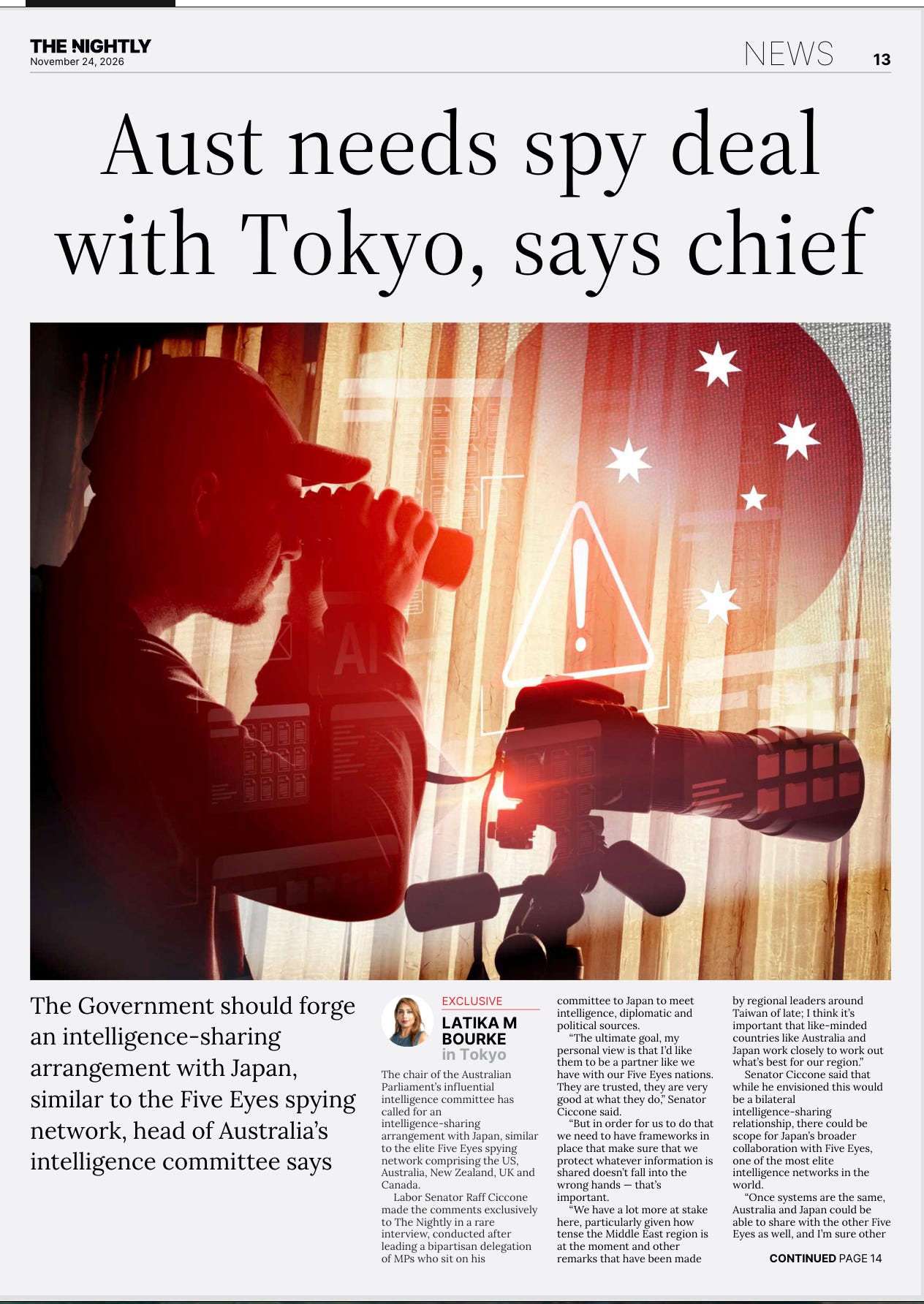
Earlier in the month, Labor Senator Raff Ciccione, who chairs the Australian Parliament’s influential intelligence committee, visited Tokyo on a bipartisan visit with some of the MPs who sit on his committee.
He rarely gives interviews, but granted me one to discuss his main takeaway of his visit — that Australia and Japan needed to establish an intelligence-sharing relationship akin to the Five Eyes. The Five Eyes comprises the United States, Australia, the United Kingdom, New Zealand and Canada and is considered one of the most elite intelligence networks in the world.
‘The ultimate goal, my personal view is that I’d like them to be a partner like we have with our Five Eyes nations. They are trusted, they are very good at what they do,’ Ciccone told me in an interview for an article that I published in The Nightly.
‘But in order for us to do that we need to have frameworks in place that make sure that we protect whatever information is shared doesn’t fall into the wrong hands — that’s important.
‘We have a lot more at stake here, particularly given how tense the Middle East region is at the moment and other remarks that have been made by regional leaders around Taiwan of late; I think it’s important that like-minded countries like Australia and Japan work closely to work out what’s best for our region.
‘Once systems are the same, Australia and Japan could be able to share with the other Five Eyes as well, and I’m sure other countries like the US would be keen to deepen their relationships with Japan as well too. They’ve already got some really good, strong frameworks and collaboration, but like us, it’s taken a while for them to build systems.’
If this were to materialise, it would constitute a tectonic leap for Japan.
But there are significant hurdles
Japan’s intelligence system, primarily led by the domestic police force, is considered to be one of the more immature amongst Australia’s strategic partners, partly due to factional infighting between the authorities and its nascent growth in the context of its post-war pacifism.
Australia and Japan share some limited intelligence already.
In late 2024, Australia joined a US and Japanese data-sharing program that shares analysis of real-time surveillance and reconnaissance data gathered from assets that monitor Chinese intrusions into Japanese territories, which the Chinese Communist Party disputes in the East China Sea.
But several obstacles block stronger cooperation, including Japan’s poor cybersecurity, lack of clearance and vetting systems, external oversight and established agencies that operate in the same way as Australia’s internal agency ASIO, overseas spy network ASIS and the analytical department of the Office of National Intelligence.
Takaichi can deliver
But if there is any leader who might deliver such reform, it is Japan’s current Prime Minister Sanae Takaichi, a China hawk and protege of the late Shinzo Abe.
‘Prime Minister Takaichi is so dedicated to reinforcing Japan’s intelligence capabilities. She is also keenly aware of the importance of the Special and Strategic Partnership with Australia. We should never miss this golden opportunity,’ Japan’s former ambassador to Australia Shingo Yamagami told me, after our meeting in his offices in Tokyo.
‘While Japan is more than happy to share its expertise and insight on the Chinese continent and Korean peninsula, Japan can gain significantly from Australia’s long-proven prowess in human as well as signal intelligence.’
Both sides benefit
While Japan’s intelligence systems may be underdeveloped, they have much to offer in terms of output.
As research fellow Sam Wendfeldtwrote in his paper for the Sydney-based United States Studies Centre, Australia would benefit from Japan’s independent satellite capability as well as Japan’s deep links and business-based data on the Chinese economy.
He told the Japan Foundation’s Indo-Pacific Conference in Nara, Japan, which I attended, that the scope could involve China’s attempts to dominate the South China Sea and Taiwan Strait.
'In the Philippines and in the South China Sea over the last few months, there’s been at least a dozen dangerous incidents on water between the Philippines and China,’ he said.
‘And they do create the risk of the triggering of the mutual security treaty, noting that the Philippines, like Australia and Japan is a treaty ally of the United States.
‘This risk and those examples talk to the real importance of the strategically aligned democratic countries, that believe in upholding the global rules-based order, and deterring conflict, cooperating together.’
He said Japan and Australia had a special role to play to ensure that the United States oversized intelligence resources worldwide, did not overshadow the specific focus on the Indo-Pacific that Australian and Japanese provides.
‘It’s really important that our two communities band together to bind the US to the region but also to ensure that our interests are protected.’
This is a development to watch.
Latika Takes is a reader-supported publication. To receive new posts and support my work, consider becoming a free or paid subscriber.