

America, América: A New History of the New World
America, América was published in April last year and was a pandemic project of Pulitzer Prize winner Greg Grandin.
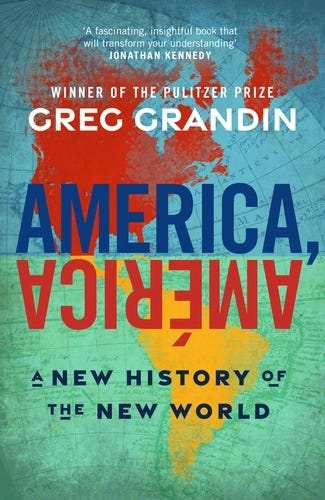
I picked up a copy at Moncole Radio around this time, thinking that following the election of Trump, a good brush-up book on American history could do me no harm.
It stayed on my bookshelf until late last year, when I knew I’d be heading back to the United States, firstly to cover for The Nightly, UNGA and then Anthony Albanese’s bilat with Trump. It’s a weird thing I do, but I always like to be trying to read a book about a significant country I’m about to visit.
To my sheer delight, it turned out to be the most fortuitous read of my life. As the Trump Administration unveiled its National Security Strategy with the Monroe Doctrine at its heart, in my hands was a book detailing the exact history of how and why the Monroe Doctrine came into being and how it has morphed to justify different US foreign policies over time.
The first thing to say is this book is dazzling, in writing, content and narrative. I am quite ashamed to admit it, but Latin America was a total gap in my knowledge; we weren’t taught it at school in Australia, and I’d had little incentive to repair the oversight in adult life. Fortunately, America, América was such a sparkling read, it was easy to quickly become immersed in the history of countries I’ve never visited (except Mexico).
Grandin is a beautiful writer and writes history richly and with just enough detail. He sweeps through hundreds of years in this book, and it is the perfect read for understanding the doctrine that has shaped MAGA’s worldview.
This book taught me how utterly coherent (that is not to say logical) Trump’s foreign policy is when viewed through the lens of Monroe. The Doctrine was formed as an anti-European policy at a time when colonisation had ravaged Latin America. America wanted Europe out of the Western hemisphere, although at that time, the Americans had no plans to try to interfere in Europe, as is MAGA’s stated goal today.
It was also written at a time when America was rapidly expanding. It is far from being 50 states at this time in history, and Monroe himself has overseen the acquisition of land from France — during his presidency, five states joined the Union.
Against this backdrop, Trump’s contemporary threats about the US acquiring Greenland and constant jokes about making Canada a 51st state can and should be taken more seriously. Expansionism, not isolationism, is the American worldview.

Another factor I appreciated as a result of reading this book was how early on the Americans resisted multilateralism and/or international/external rules. As a result of the brutal colonisation, Latin America emerged as a hotbed of intellectualism and liberalism, particularly relating to the proposals of international governing systems. The US viewed this then, as it does today, as attempts to rule it from the outside and was fiercely opposed.
Finally, Grandin documents how various Presidents seized on Monroe to adapt it to follow whatever foreign policy they wanted. In the end, it became a crutch for justifying US interventions as we see taking place today.
Essentially, Monroe begins as something of a damp squib, primed for domestic politics that becomes an amorphous blank cheque as long as Presidents can justify the projection of US power in America First interests.
I honestly think this is one of the most underrated history books that explains today out there, and I cannot recommend it enough.
And in exciting news, Greg will be on my podcast tomorrow!
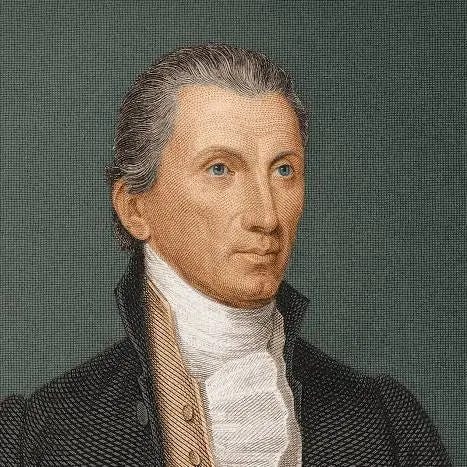
President James Monroe
James Monroe turns out to be a hugely interesting and perhaps overlooked ‘founding father’ President.
In 1799, Monroe was elected governor of Virginia. As governor, Monroe increased state involvement in education and transportation, he also invested in the state militia.
He supported the candidacy of Thomas Jefferson in 1800, by appointing election officials favourable to Jefferson to ensure his presidential victory.
Jefferson capitalised on this support and Monroe’s ambassadorial past, by sending him to France to assist in the Louisiana Purchase.
While negotiating, Jefferson made Monroe the ambassador to Britain. Jefferson gave orders to purchase only West Florida and New Orleans for at most nine million dollars, Monroe disobeyed Jefferson and bought all of Louisiana for fifteen million dollars. Monroe’s actions did not anger Jefferson; rather he was very pleased with the purchase, the president even offered Monroe the position of the first governor of the new territory, he declined and remained in Europe to continue as ambassador to the British.
…
In 1811 Monroe was once again elected the governor of Virginia; however, in April of that year, Madison appointed him Secretary of State, forcing him to leave the gubernatorial position. By selecting Monroe, Madison sought to quell instability within the party, along with reconciling with his former friend. As Secretary of State, Monroe worked diligently to prevent the practice of impressment. He found progress with the French, however, the British would not negotiate, and in 1812, Monroe joined Henry Clay and the ‘War Hawks’ and called for war. Madison followed Monroe’s advice, and the War of 1812 began.
The War of 1812 cemented Monroe into the public eye as a leader. Monroe served as Secretary of State, where he sent John Quincy Adams to negotiations in Ghent. In 1814 Madison made Monroe Secretary of War, and Monroe resigned from his position as Secretary of State, but Madison never appointed a new Secretary of State, and as a result, for a brief time, Monroe served a joint role as both Secretary of State and Secretary of War.
After the war concluded in 1815, Monroe decided to run for president in 1816. Monroe had become a hero through his leadership in the war. Monroe won the presidency with an electoral vote of 183 to 34.
The Doctrine
After doing so much reading about the Doctrine, the text itself is fairly dense and dull. A bit of a let-down if I’m honest.
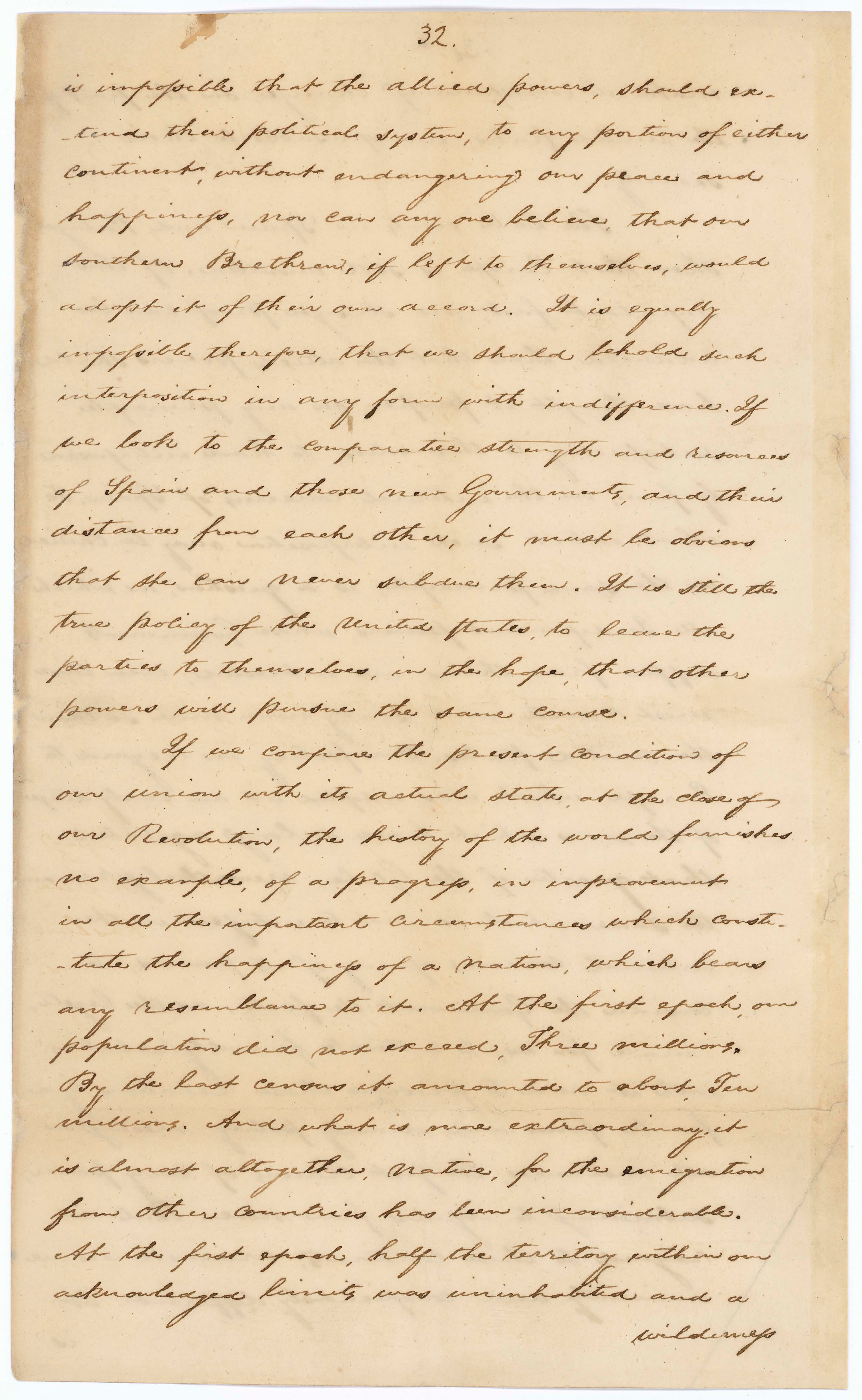
The citizens of the United States cherish sentiments the most friendly in favour of the liberty and happiness of their fellow-men on that side of the Atlantic.
In the wars of the European powers in matters relating to themselves, we have never taken any part, nor does it comport with our policy to do so. It is only when our rights are invaded or seriously menaced that we resent injuries or make preparation for our defence.
With the movements in this hemisphere, we are of necessity more immediately connected, and by causes which must be obvious to all enlightened and impartial observers. The political system of the Allied powers is essentially different in this respect from that of America. This difference proceeds from that which exists in their respective Governments; and to the defence of our own, which has been achieved by the loss of so much blood and treasure, and matured by the wisdom of their most enlightened citizens, and under which we have enjoyed unexampled felicity, this whole nation is devoted.
We owe it, therefore, to candour and to the amicable relations existing between the United States and those powers to declare that we should consider any attempt on their part to extend their system to any portion of this hemisphere as dangerous to our peace and safety.
With the existing colonies or dependencies of any European power we have not interfered and shall not interfere. But with the Governments who have declared their independence and maintain it, and whose independence we have, on great consideration and on just principles, acknowledged, we could not view any interposition for the purpose of oppressing them, or controlling in any other manner their destiny, by any European power in any other light than as the manifestation of an unfriendly disposition toward the United States.
In the war between those new Governments and Spain we declared our neutrality at the time of their recognition, and to this we have adhered, and shall continue to adhere, provided no change shall occur which, in the judgment of the competent authorities of this Government, shall make a corresponding change on the part of the United States indispensable to their security.
So this guy was on the money…
The more reading I’ve done on Monroe and Trump-world, the more I’ve realised, (somewhat aghast) that it was there all along if you knew what you were looking for.
Juan Gabriel Tokatlian, Professor at Universidad Torcuato Di Tella in Buenos Aires, Argentina, warned in an article in November 2024, that Trump would revive Monroe.
…there are several potential ways in which a renewed Monroe Doctrine could take shape from 2025 onward.
In addition to defence issues, concern over China’s role in Latin America would spread to include a variety of matters involving technology, investment, trade, drugs, and diplomacy. Trump may well rely on an intimidating policy base of pressures, sanctions, and retaliations to try to persuade governments to turn away from Beijing—even though, if recent history is any guide, Washington is unlikely to offer much of an alternative when it comes to investments or help with infrastructure.
Iran’s footprint in the region is also likely to garner more attention, especially given that country’s longstanding alliances with Venezuela, Cuba and Nicaragua. Given Trump’s previous abandonment of a deal regarding Iran’s nuclear program during his first term, Iran may shift from being seen as an annoyance in the region to something more overtly ‘malign’—to be dealt with more forceful policy both in the Middle East and in Latin America.
But the biggest shifts could be in Washington’s treatment of Latin American governments themselves. Trump’s last Secretary of Defence, Mark Esper, in his book Sacred Oath, paints a vivid picture of Trump’s obsession with Mexico, Cuba, and Venezuela. For example, he proposed launching missiles into Mexico to obliterate drug infrastructure, imposing a blockade of Cuba, and engaging in military action against Venezuela.
A second Trump White House may well lack some of the more rational voices that averted more rash actions the first time around. And with Nicolás Maduro continuing to rely on violence and repression to subdue the political opposition in Venezuela, the temptation to intervene may only grow.
…
A hardline policy against migrants, including military deployment in the Caribbean Basin, should not be discarded, as well as an expanded role of the U.S. Southern Command in the fight against drugs and organised crime in large parts of the region.
The Monroe Doctrine is an old idea. But it hasn’t been consigned to the dustbin of history just yet.
The Donroe Trap
Donald Trump proudly calls his addition to the Monroe Doctrine the Donroe Doctrine. He bragged about this description the night he held his media conference following the successful capture of Venezuelan President Nicolas Maduro.

But Leon Hadar argues Monroe has always been a bogeyman for interventionist presidents.
The Monroe Doctrine belongs to a bygone era of American history. Its invocation in the twenty-first century reflects not strategic wisdom but rather the intellectual bankruptcy of a foreign policy establishment unable to imagine alternatives to interventionism. The doctrine’s promise to keep European powers out of the Western Hemisphere has morphed into a presumptuous claim that Washington should manage all regional affairs—a mission impossible that serves neither American interests nor regional stability.
The irony is rich: the same voices warning about Chinese ‘debt trap diplomacy’ in the Caribbean support policies that would trap the United States in an endless cycle of military interventions, nation-building failures, and budgetary haemorrhaging.
The same officials who claim to defend American interests advocate commitments that drain national resources while producing minimal security benefits.
The path forward requires intellectual courage—the willingness to admit that American military power cannot solve every problem and that restraint often serves national interests better than intervention. It demands recognition that the Caribbean’s proximity to the United States creates neither an obligation nor a right to dominate the region’s political affairs.
Until Washington abandons the Monroe Doctrine’s interventionist legacy and embraces a foreign policy of realistic restraint, the Caribbean will remain a theatre for costly, counterproductive military adventures. American taxpayers and Caribbean peoples alike deserve better than this tired, failed approach masquerading as a strategic necessity.
And that’s my list for this week.
📻 On Saturday, I appeared on Monocle Radio to discuss the week in global affairs.
On Monday, I reviewed the day’s newspapers for The Globalist.
I was then in Galway, Ireland, moderating a panel on the future of geopolitics for Siren’s Fusion 2026 conference.

🎙️ And on the ABC’s Global Roaming podcast with Geraldine Doogue, we interviewed Michael Wesley about his claim that Australia’s diplomatic and strategic focus should be Southeast Asia (I was not convinced). Listen on all podcast apps and here.
Please do send me anything that’s caught your eye, I enjoy knowing what you’ve been reading.