

Farage stung by undercover journalists
Verbatim media has caught Reform operatives and leader Nigel Farage suggesting ways to circumvent British electoral laws banning foreign donations.
The sting, one year in the making, was broadcast by Channel 4 and online on the eve of Reform’s annual conference in Birmingham.
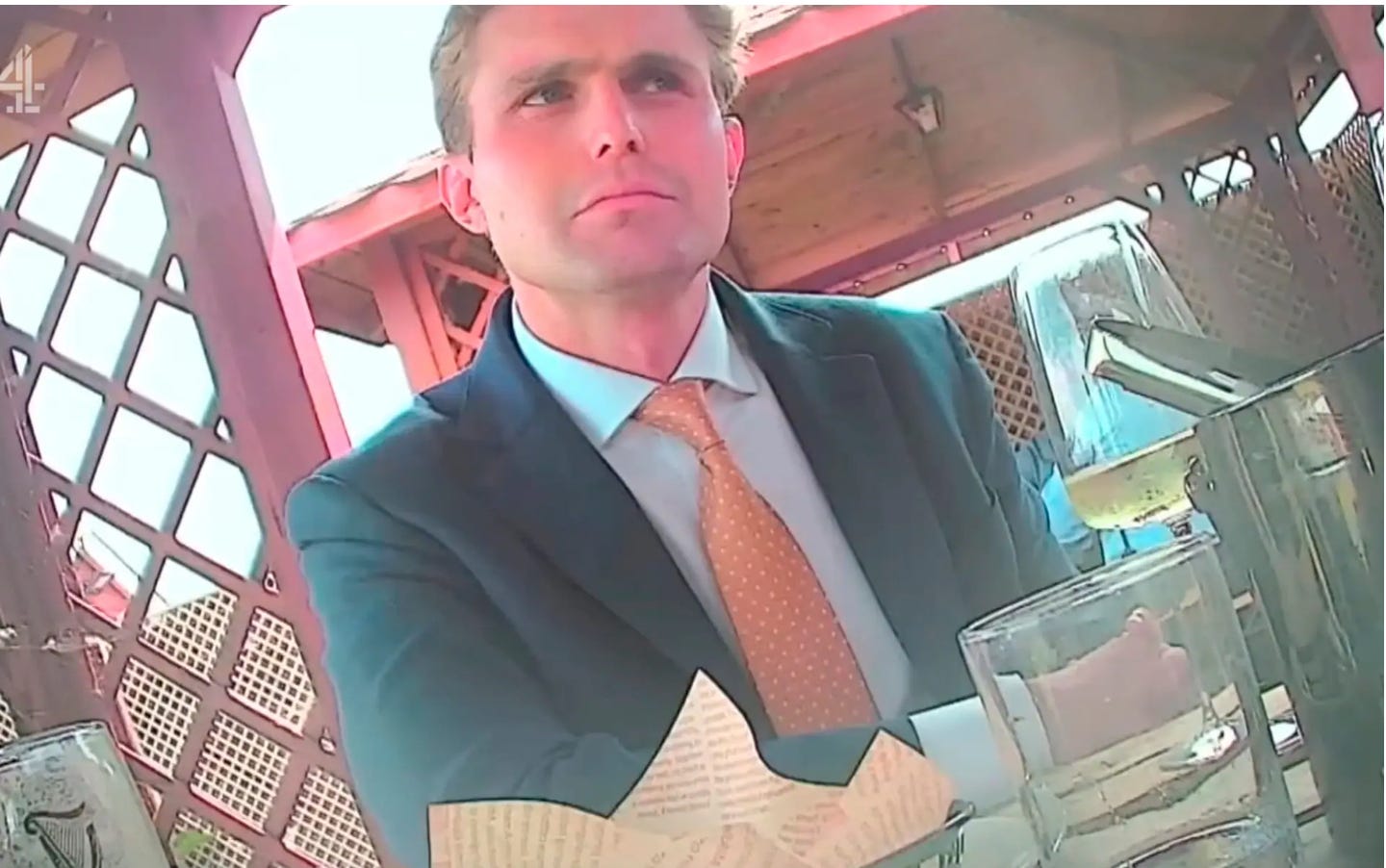
The footage showed the undercover journalist, posing as the British son of a wealthy American, teasing out a plot by Reform aides to have the American donor pay for polling that would be published in the conservative press with no traces to Reform (not disclosing who commissioned the polling is against the rules).
After this was done, and materially affected key decisions by the Labour government under Keir Starmer, the journalists then graduated the plotting to a lunch with Farage and his right-hand man Dan Jukes. The pair suggested the funds be funnelled from the US donor to Reform via his British son.
Highly recommend watching the report in full.
At another meeting, while discussing a near-identical polling scheme to what the undercover team had already paid for, Mr Orr said that ‘if there was any way of seeing it, it would technically be a donation-in-kind’ but added: ‘Is anybody gonna find out? Am I gonna tell anyone... obviously not, so the reality is we could easily get away with it.’
He also joked that they could ‘literally do the old John Le Carré - you print it off, put it in a brown envelope, drop it off somewhere.’
Mr Orr suggested there would be little chance of consequences because the proposal was only for ‘technical breaches’ of rules and the Electoral Commission was ‘completely useless’. He also said the regulator was ‘so dumb and ineffective’. They did not go through with the specific plan for polling discussed at that meeting.
…
In another meeting with the UK-based undercover reporter, Mr Jukes described their polling arrangement as ‘highly important’ and said they had big impact, were relatively good value for money ‘and they don’t show up anywhere in public records’. He added: ‘Those little clandestine projects are so valuable.’
At a Reform UK reception, Mr Jukes introduced the undercover reporter in one conversation as: ‘key donor for off the book project’.

Farage drops ‘contractors’ Orr and Jukes
By morning both James Orr and Dan Jukes were gone from their positions, with Farage trying to diminish their roles in the party to that of ‘contractors.’
There is no Farage without Jukes, who was captivated by the Brexiteer when he saw him speak at his school as a student.
The loss of Dan Jukes and James Orr to an undercover sting over — yet again — questionable Reform UK donation practices cannot be underestimated.
Jukes is known as Farage’s most loyal attack dog — a communications chief who began unflinchingly batting for his boss as a teenager and has lasted for more than a decade in the Farage orbit. They are so close that their relationship is often spoken of as being more like father and son. Orr was Reform’s big policy brain. A Cambridge academic who was leading work to build a robust platform for governance, Orr is a theologian with deep links into the MAGA movement, including a friendship with U.S. Vice President JD Vance.
Is it the start of the end?
Fraser Nelson says while Reform voters won’t care, enough others may.
Cutting Jukes adrift won’t end the questions. Yet again, we see how Reform UK operates: the network of Mayfair clubs, funny foreign money and lack of transparency. Opinion polls arranged by Reform and sold as independent research — with the pollster’s connivance — to this newspaper and others. Such stunts are vital for the overall cause, Jukes was recorded as saying. So what other stunts are there? How much of our debate is being rigged in this way? How many pieces of ‘research’ are funded or even conjured up by this carefully curated ecosystem?
The theme of Reform UK’s conference is ‘the first 100 days’ of their government. It’s still plausible. The table plan for the VIP dinner at Reform’s ‘business day’ was a Who’s Who of corporate Britain. Banks and bosses are hedging their bets, and understandably so. The volatility in British politics is dizzying. Although Reform has fallen in the opinion polls and now vies with the Tories for third place, who would be so bold as to declare it out of the game?
Reform is scandal-resistant — if not quite scandal-proof — because it is not just a political party. Like the Scottish National Party, it is a cause. The SNP showed the world how a cause can endure all kinds of scandal, even leading figures subjected to police investigations and court trials, and still keep its base. One woman I met in Birmingham wore a T-shirt making this point: ‘Attacked: still standing. Smeared: unstoppable. Reform UK united.’The more Farage is attacked, she told me, the harder she’d campaign for him.
But to win, Reform needs floating voters — and they seem to be falling away quickly, dismayed to see this new party more in cahoots with dodgy billionaires than the establishment it rails against. Scandal now seems to chase Farage everywhere. His big speech ended up being delayed by protesters who made it on stage with a Monopoly-style placard saying, ‘Collect £5 million’. And then, when he started, hecklers stopped him three times. All told, it felt more the end than a beginning.
Ukraine and Russia erode their own red lines
Whatever red lines existed in Russia’s war against Ukraine are fast eroding. Vladimir Putin has been pounding Kyiv, the capital, relentlessly and today, in broad daylight, attacked the building that houses the country’s spy agency in downtown Kyiv.
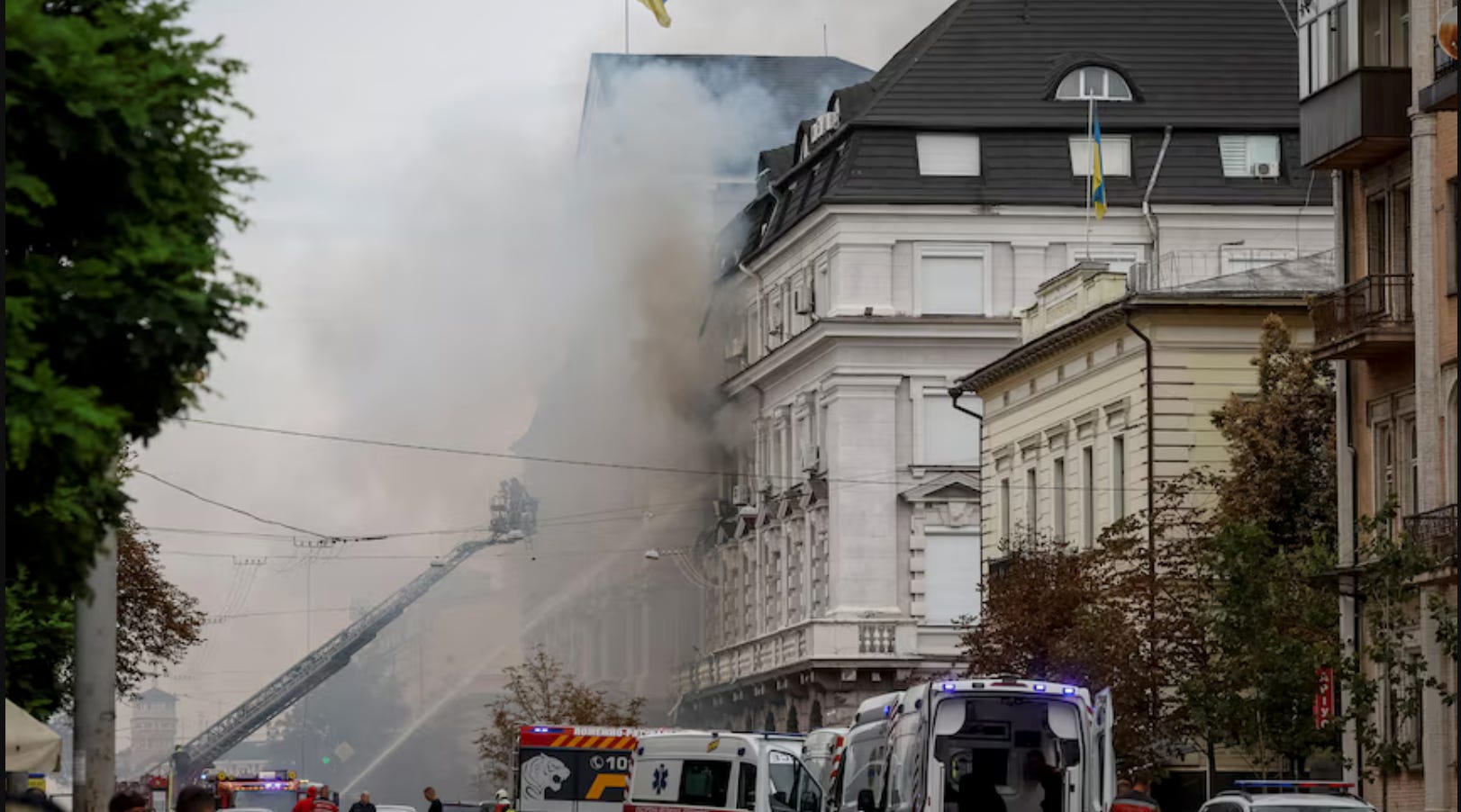
It is hard to state how central an attack this is — it occurred opposite St Sophia’s Cathedral, which has been largely a no-go zone as it is an area frequented by government, overseas diplomats and foreign visitors and home to the international hotels where visiting dignitaries and many overseas guests semi-permanently live. I am never not in this area when in Kyiv, as it is typically one of the safer areas for the reasons above.
I think in Sydney terms it would be like targeting a government building on Macquarie Street.
One small piece of potentially better news is that US President Donald Trump is despatching his negotiators, son-in-law Jared Kushner and Steve Witkoff, to Moscow and Kyiv as early as this weekend.
U.S. President Donald Trump confirmed Friday that envoys Steve Witkoff and Jared Kushner will travel to Moscow and then Kyiv over the weekend and into early next week. The U.S. has not provided more specific timing for the stops.
‘They are bringing with them a proposal to end the war,’ Trump said.
This would be their first visit to Kyiv. U.S. efforts to negotiate a settlement have yet to produce a path to peace.
Zelenskyy said Friday that he was expecting Witkoff and Kushner to visit Kyiv on Sunday, after visiting Moscow. He said in a Telegram post that Ukraine will refrain from airstrikes during the negotiations and called on Russia to reciprocate to allow the talks to proceed safely.
‘As with previous diplomatic visits by the American side, we will ensure the normal functioning of Russian airspace so that the negotiators can arrive safely. We are concerned about their safety, not about Russia,’ Zelenskyy said.
German far-right supporters don’t share Russian anxiety
There is an election to watch this weekend taking place in Germany. The eastern state of Saxony-Anhalt could vote for the far-right AfD to lead it’s state parliament.
Surprise, surprise, Kremlin mouthpiece Kirril Dmitriev is retweeting his support of the AfD’s national leader Alice Weidel under the pretext of pretending to care about the German economy.
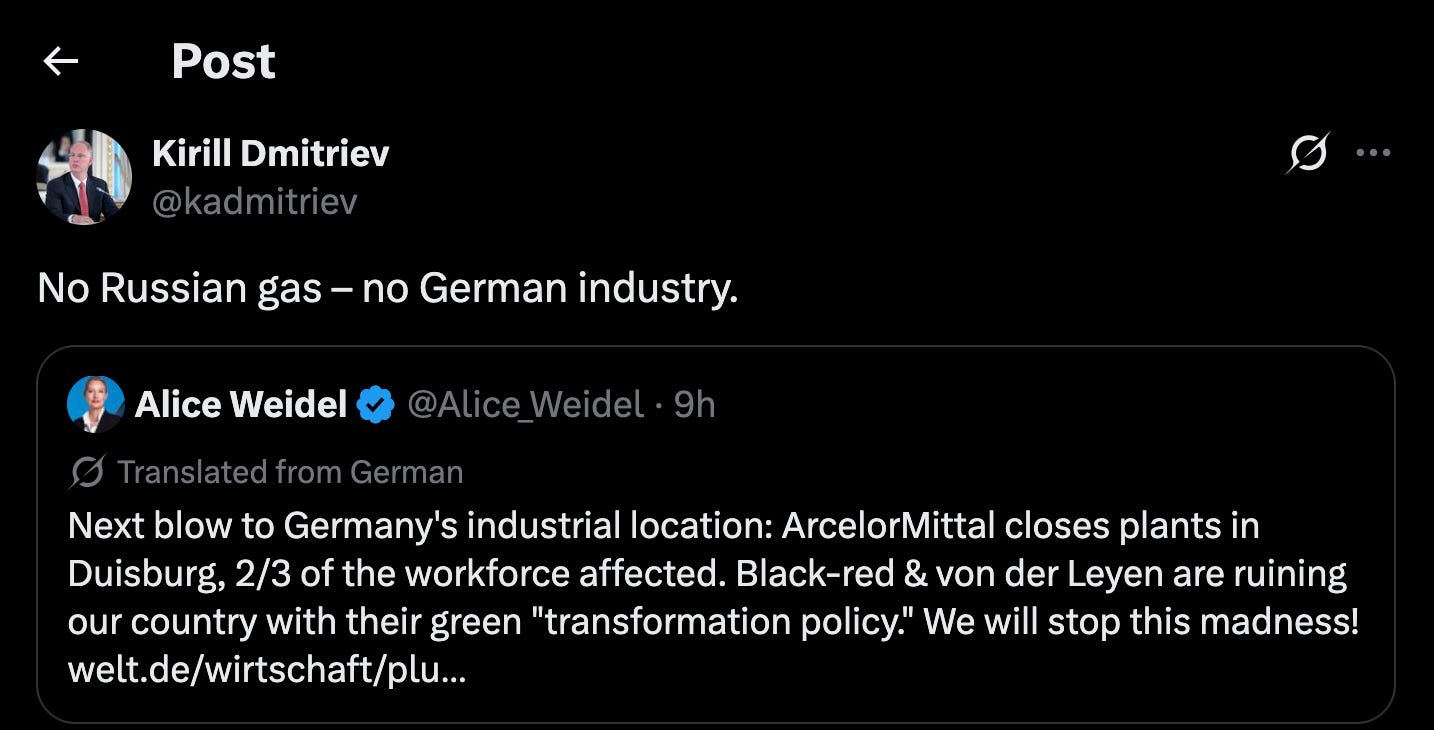
But the truth is that AfD’s voters simply do not see Russia as a threatening neighbour, unlike the now majority of Germans.
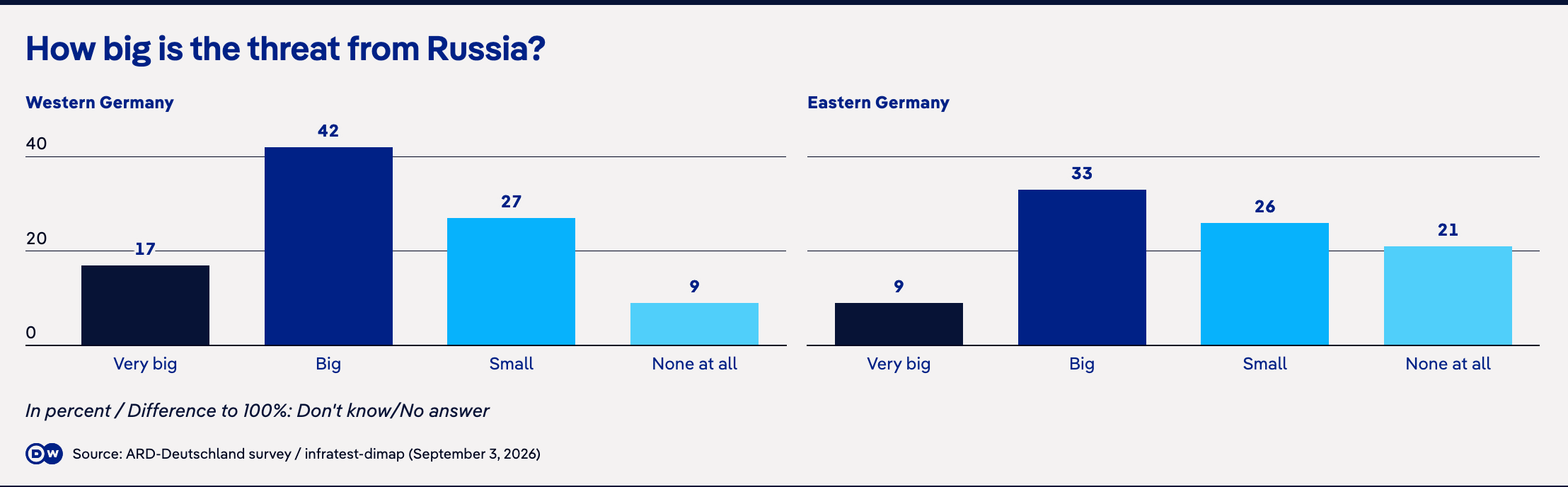
Nearly half of citizens in eastern Germany, for instance, feel only slightly threatened, or not at all, by Russia. The same goes for supporters of the far-right Alternative for Germany (AfD), some of whose prominent figures have expressed support for Russia. The survey found that two-thirds of AfD supporters consider the threat from Russia to be low.
The same divisions in the German population emerge on the question of arms exports to Ukraine. Just over half of Germans consider the country’s military support for Ukraine appropriate, or think it should even be expanded, but for just over four in ten Germans, that support goes too far. Opposition to sending weapons to Ukraine predominates in eastern Germany and among AfD supporters.
And that’s my list for this week.
Please do send me anything that’s caught your eye; I enjoy knowing what you’ve been reading.
📻 For my media, I joined Times Radio to discuss UK politics and reviewed the newspapers on Moncole Radio’s The Gobalist.
This week I was in Bled, Slovenia, for the Bled Strategic Forum where I moderated a panel on the EU and Indo-Pacific and ‘Deterrence without Stability.’
Next week I will be in Kyiv at the YES Conference.