

The Bayeux Tapestry: A Night Divine 🌟🌟🌟🌟🌟
I waited for a whole day in the virtual queue to get these tickets, which sold out in an instant for the year, and boy, did that patience pay off.
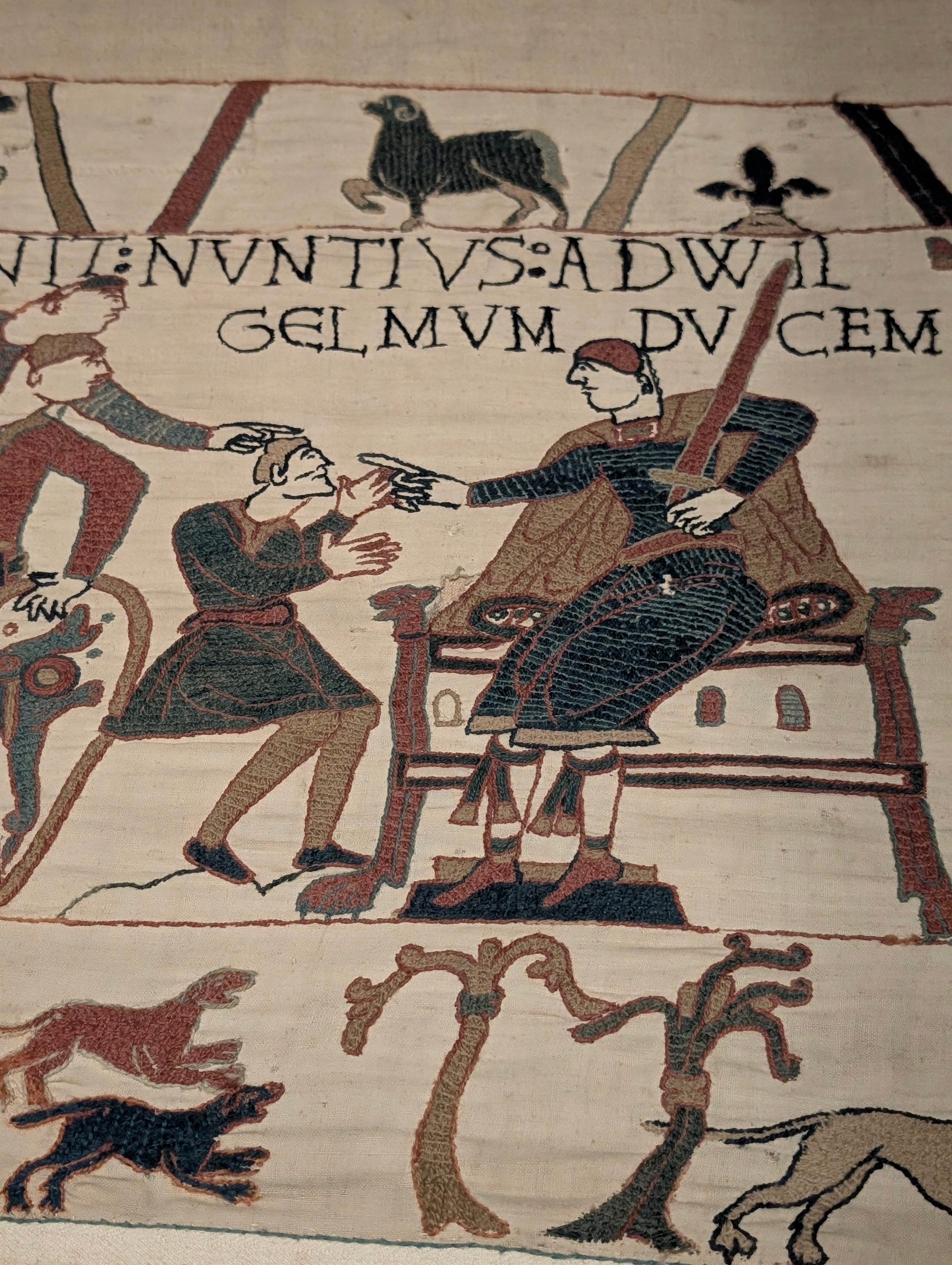
Late last night, with just a few dozen people shuffling in a single line the full 68.3 metres in a black room, I viewed the Bayeux Tapestry.
The British Museum has brought the Tapestry from Normandy, France to London until July next year. And it is sublime and divine. The experience was immersive and bordered on spiritual. (Although the British Museum could really do away with the constant naggers who tell you at every second to queue and shuffle. You are somewhat raced through it and it does dampen the aura somewhat.)
I was stunned at how vibrant the 11th-century artwork is, and how much movement and activity it captures. I thought I would be seeing a faded, perhaps frayed and dulled piece of linen that would look like hieroglyphs on fabric.
How wrong I was. The Tapestry bursts with life and animation, and even the figures depicted have very easy-to-read facial expressions. It was astonishing how vivid and graphic embroidered battle scenes could be.
The British Museum will open its next round of tickets next year. If you can get them, get them. And for my overseas readers, yes, this is absolutely a reason to justify a trip to London. C’est magnifique!
And now here it is, in front of my eyes, close enough to touch if it wasn’t behind a glass screen of such high quality you never catch a reflection. The British Museum’s display of this wonder is perfect. It’s laid out in its case, the length of a gallery, which you reach after some archaeological foreplay involving armour, quotes from chronicles and info screens. Then you see the colours of the tapestry below you from a parapet – russets, greens, yellows – after which you simply start at the beginning and follow the story rightwards. Surrounded by darkness and picked out by finely adjusted lighting, the Bayeux tapestry shines. My only quibble is the ethereal soundtrack – shouldn’t there be drums, oliphants, troubadours?
I managed a pretty satisfying eyeful in under an hour, although more than the allotted 40 minutes. This is pacy art: it hurtles along. In fact, that’s how it embraces you. Your heart pounds with a sense of doom and destiny. This is, you realise, the greatest battle in art.
…
It’s the 11th-century answer to Eadweard Muybridge’s motion photograph sequences. We follow the change in speed as if it was happening to a single figure. The Normans are so disciplined they seem be to one single, lethal horseman – and that is why they will win.
While you are dragged forward, you are also led up and down, to meander in a marginal world of monsters and myths. Bizarre goings-on in the borders above and below the action constantly interrupt the drive of the story. The gryphons, dragons and square-winged, hieratic birds of prey seem much bigger and bolder in life than reproduction and harder to ignore.
I thought I’d detected some structure to it all: the top margin is more ordered and sublime, suggesting the heavenly sphere (Halley’s Comet speeds through it like a rocket), while the creatures below look earthy and sinful. Then I saw two bare-chested female centaurs at the top spreading their arms out as if to say: “Lo and behold!” So much for logic.
The great thing about a border is that you can break it. When William’s ships speed across the Channel, their bulging, wind-filled, multicoloured sails fill the upper space. As the Battle of Hastings gets bloodier, bodies and body parts pile up in the lower one.
Rioting France and the Welfare State
At what point do Western leaders acknowledge and respond to the failed economic model that voters all around the world are reacting to, with varying shades of viciousness?
Surely a new Grand Bargain is needed that acknowledges both capitalism and socialism, as they have been sold and rolled out have failed. Welfare states are not sustainable, but nor is the US model of entrenched inequality that creates oligarchy and trillionaires, leaving the rest to ill-afford the cost of living.
This week it was France’s turn to signal its anti-establishment ferocity, with looting, burning and violent protests in Paris. Riots and protests aren’t exactly oddities in France. And these sorts of protests are not uncommon across Europe; remember London’s bout of similar riots in 2011.

Yet, even by French standards, these were exceptional as student protests morphed into wider complaints about the cost of modern living, inequality, as well as thugs hijacking the demonstrations and looting designer stores. And these collide with France’s precarious fiscal position and the very real prospect that Emmanuel Macron’s legacy as President will be to open the doors of the Élysée to populist Marine Le Pen.
Noah Smith says France needs an austerity moment, but Western societies are caught in a trap of not recognising the difference between a welfare state and an unsustainable model.
France is in a difficult position here. Its membership in the EU, and its location near to other French-speaking countries like Belgium, Switzerland, and Luxembourg, make it trivially easy for rich French people to pick up and move to other countries if they see their fortunes under threat of confiscation.
France could, of course, try taxing the middle class to pay for expanded social spending, perhaps by an increase in the VAT. But this burden would fall on many of the same people who are now protesting and rioting in the streets, so it’s probably a political nonstarter as well.
In fact, the current riots are making the strains in France’s bond market worse, by making the politics of austerity seem more intractable. Various groups of protesters and rioters are demanding enormous amounts of additional government largesse — billions of euros of increased spending on schools, increases in pensions, increases in social benefits, and even subsidies for consumer goods like fuel. That demonstrates that there’s still enormous grassroots political pressure for higher government spending; even if France’s leadership doesn’t cave in to this pressure, leaders will probably be averse to making the deep cuts to spending required to put France on a sustainable fiscal path.
And that, in turn, is probably making it harder to enact any of the spending that the protesters are demanding. When protesters demand increased spending, bond markets respond by charging higher rates on French government borrowing. That increases interest costs for the government, which makes it harder to raise social spending — the exact opposite of what the protesters wanted.
Fundamentally, the French riots show the limits of the European left-liberal welfarism that has been the region’s default approach to governance for the last half-century — and which American progressives want to emulate. The French populace — or at least a powerful chunk of it — simply doesn’t seem to be able to recognize the difference between a sustainable welfare state and an unsustainable one. Instead, social benefits seem to be a one-way ratchet — higher benefits raise expectations for even higher benefits, until even the most milquetoast and inadequate of austerity measures end up causing cities to burn.

Desperate GOP throws spaghetti at the wall
Donald Trump has thrown his support behind a Republican ad run by Vivek Ramaswamy who is running to be Ohio Governor. The ad represents a new low in MAGA’s tactics. It features the mother of his Democratic rival saying her daughter is a liar. Amy Acton has said she was sexually abused by her stepfather as a child and she was removed from her mother’s care at the age of 12.
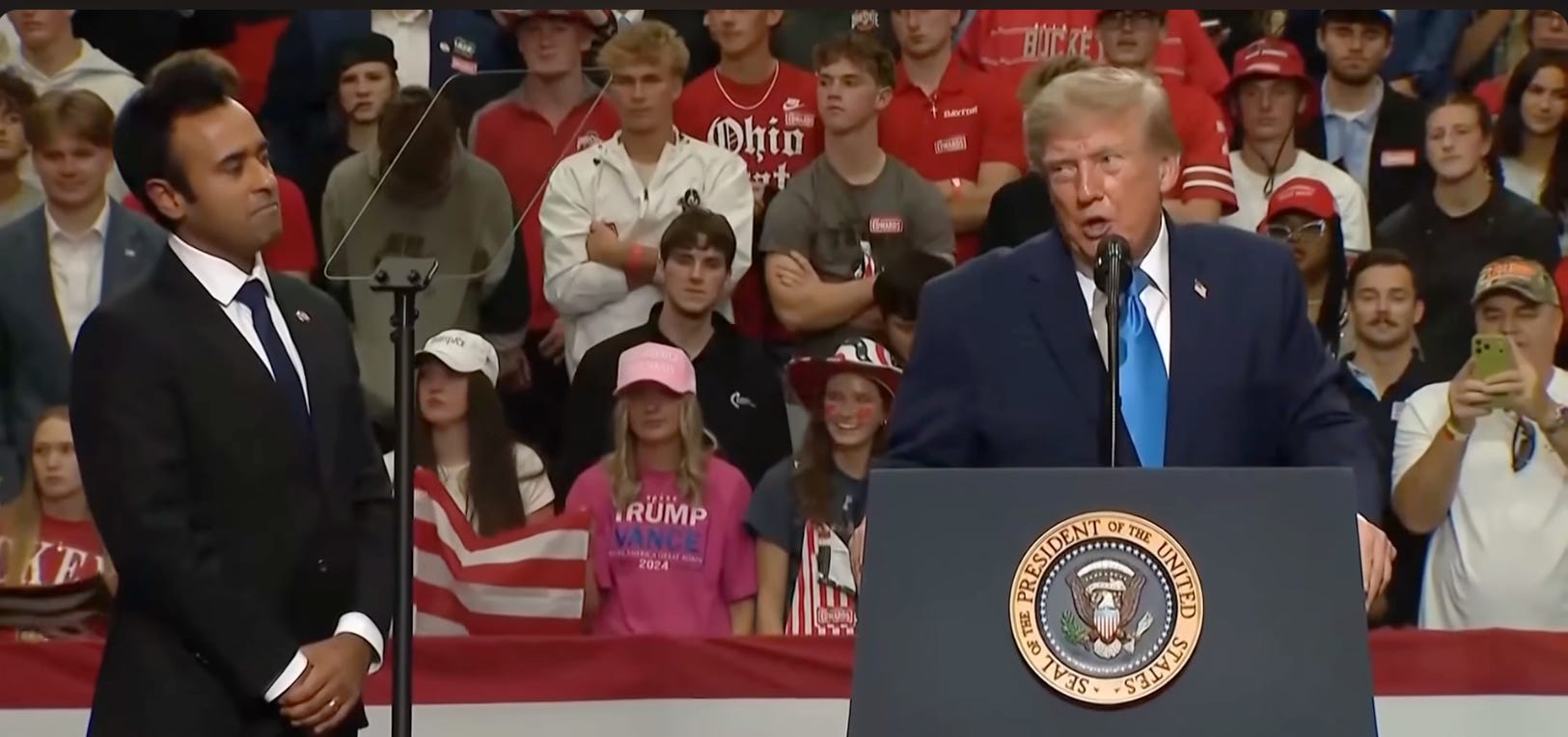
Ramaswamy is unrepentant and will spend $3 million promoting the ad, amid Republican fears that the party is going to get wiped out in the midterms, largely viewed as a scorecare on Trump’s second term.
It is a pattern repeated across the US, said Ford O’Connell, a political strategist who has worked on numerous Republican campaigns. “People may say it’s controversial, but you’re in such a close race right now, you don’t know what’s going to put you over the top,” he said. “So now you’re at a point where everybody is throwing spaghetti at the wall, particularly in the close races, whether it’s Ohio, whether it’s Michigan, whether it’s Texas.”
Republicans are outspending Democrats, with monitoring group AdImpact reporting that the GOP spent 50%, or $200m (£150m), more on ads than the Democratic party last month.
…
But Peter Loge, a former campaign strategist and now associate professor of media and public affairs at George Washington University, is not sure these attacks will chime with voters in a very different political environment when cost of living is the top concern.
“If a candidate is coming in and saying, ‘but what about a boy playing girls’ sports?’ voters are saying, ‘yeah, I don’t really like that, but I’m a farmer, and diesel is costing me my mortgage,’” he said. But with Trump’s approval ratings languishing, making it personal has become the go-to strategy, he added.
In Michigan, Democratic Senate candidate Abdul El-Sayed is being targeted with ads about his Muslim faith, insinuating extremist ties. In Maine, an ad aired saying that Democratic challenger Troy Jackson is married to his second cousin, featuring a song with the line “if he’ll screw his own family, he’ll screw yours, too”.
For now, the Democrats are holding back on reciprocating. Talarico this week released an advertisement focused on hope, echoing the Obama-era optimism. Veteran Democratic strategist David Axelrod praised it for “playing against the hateful tenor of our times”.
But Loge cautions that Republicans ads may put off voters of all stripes. “Historically, negative ads tend to decrease turnout: people just don’t like them.”
Susan Collins secures tariff exemptions for Canada
In a sign of how real the threat to Republicans are, the moderate Republican Senator Susan Collins from the border state of Maine, has secured some last-minute tariff exemptions on Canadian goods, such as plywood sheets, paper products, machinery and refrigeration equipment, and packing crates and boxes. She made the announcement on social media.

But shortly after, the White House issued a statement saying the goods exempted would be offset with tariffs on valves, carpets and waste products.
From Washington, CTV News political analyst Eric Ham said the exemptions are ‘all about politics.’
‘The internal polling data must show that Susan Collins is in deep, deep trouble,’ he said. “What we’re seeing here is, clearly, Republicans are sounding the alarm about what is happening just 10 days out from the election.
‘And right now, we see that those tariffs have been causing tremendous angst for American voters.’
Ham said his assessment of this and other recent comments from Trump, are that it’s the president ‘to do his level best to give his candidates a lifeline as voters are heading to the polls.’
During an overnight press conference in Istanbul, hours before Trump’s comments, Carney said Canada was ‘continuing to engage with the US government.’
‘We continue to be ready to sit down in good faith to negotiate a trade deal that is in both of our interests. Of course, we’re looking for the interests of Canadians, we don’t care about the timing of that,’ he said.
‘We could sign it [a deal] this afternoon if the U.S. were there. If it has to be months from now or longer than that, or another administration before a proper deal comes into place, we would do that,’ the prime minister told reporters.
Pressed on how much the timing matters, Carney said Canada would ‘drop everything’ if the Americans were ready to negotiate in good faith, but the chance of that happening before the midterms is ‘up to the United States, they’re a little hard to predict.’
The two men spoke on Wednesday ‘for quite some time,’ according to the prime minister. Sources have indicated to CTV News that Canadian officials haven’t ruled out the possibility of a snap trade deal before next month’s midterm elections in the US, but hope remains faint.
Meanwhile, Washington’s envoy in Ottawa has accused senior Canadian leadership of political interference ahead of those elections. The claims surround various officials’ activities south of the border. Among those named was Industry Minister Melanie Joly, who on Thursday refuted the claims.
Bee immunity
It could just be an old wives tale but as soon as I feel myself getting sick I run for honey. Turns out bee hives are an incredible chemical mix of immunity.

…we sampled 24 colonies from five apiaries in New South Wales, collecting honey, propolis, pollen, wax, and nurse and forager bees.
We used DNA sequencing to map bacterial and fungal communities, tested the ability of hive materials to inhibit microorganisms, and used nuclear magnetic resonance spectroscopy (a chemical fingerprinting technique) to investigate their composition.
This allowed us to look at the hive as one connected system.
What we found was striking.
A healthy hive is not a sterile one. Many of the microorganisms living in and around a colony are harmless or beneficial, so eliminating them all would be neither possible nor desirable.
Instead, the colony uses different kinds of defence in different places: selective protection around the vulnerable brood and broader antimicrobial activity in more exposed parts of the hive.
Different materials also have different antimicrobial chemistry. For example, honey relies heavily on hydrogen peroxide – the same molecule in a bottle of antiseptic.
Propolis leans on flavonoids, the same class of plant compounds that give red wine and green tea their antioxidant kick.
Pollen’s defences look more like fermented food, rich in the short-chain acids produced by fermentation.
Rather than relying on one all-purpose disinfectant, the colony combines multiple types of antimicrobial activity across different parts of the hive. In effect, the hive has a chemical floor plan for disease defence.
And that’s my list for this week.
Please do send me anything that’s caught your eye; I enjoy knowing what you’ve been reading.
📻 For my media this week, I joined the BBC’s Radio Scotland to discuss the horrific attack on Australian MP Helen Haines.
🎙️ On the ABC’s Global Roaming, Geraldine Doogue and I discussed Europe’s war with Russia, and we replayed our interview examining how to protect women in politics.