Trump withdraws US troops from Germany
And so it begins. The Trump Administration has ordered the withdrawal of US troops from Germany.
The move reflects MAGA’s broader desire to shift responsibility for European security to the Europeans, but also the movement’s open hostility towards NATO.
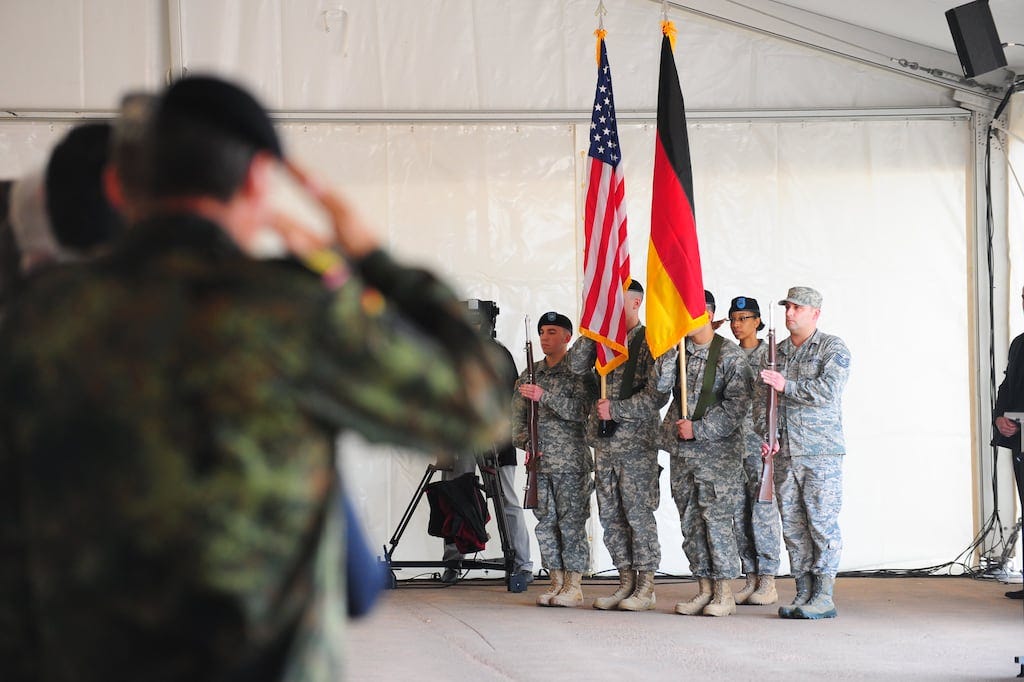
Germany is rapidly rearming with defence expenditure to reach 3.1 per cent of GDP next year.
But it also comes amid a bitter spat between US President Donald Trump and the German Chancellor Friedrich Merz.
Merz has been highly critical of Trump’s war in Iran and this week said that Iran had humiliated the US.
Trump returned serve by criticising Merz’s performance. He also floated the prospect of reducing US troops in Germany. Currently, 36,000 US troops are stationed in Germany.
In a statement, Pentagon spokesman Sean Parnell said the order had come from Secretary of Defence Pete Hegseth.
‘This decision follows a thorough review of the Department’s force posture in Europe and is in recognition of theatre requirements and conditions on the ground,’ he said.
‘We expect the withdrawal to be completed over the next six to twelve months.’
…
The US military deployment in Germany is by far its biggest in Europe, with about 12,000 troops in Italy and a further 10,000 in the UK.
Many are stationed at Ramstein Air Base outside the south-western German city of Kaiserslautern.
And while Trump has proposed US troop reductions in Germany before, they have so far not come into effect.
Only Japan hosts a larger US troop presence.
Cars, too
Trump also threatened to hit Merz economically, announcing that he will raise tariffs on European cars and trucks to 25 per cent from next week.
This would violate the trade deal that Trump struck with EU Commission President Ursula von der Leyen in Scotland last year, which Trump has previously threatened to renege on regarding Greenland.
This measure is aimed squarely at Germany.
The USA is traditionally one of the most important foreign markets for German car manufacturers, especially for Porsche, BMW and Mercedes.
In any case, the industry was hit hard by the tariffs last year: Although 27.5 per cent initially applied, this fell to 15 per cent in August following the deal with the EU. However, this is still six times as much as the 2.5 per cent that previously applied. The latest escalation is likely to leave car managers shaking their heads once again.
After all, car exports from Germany to the USA already collapsed last year as a result of the tariff increases.
‘Trump has hit the car industry in Germany and Europe hard,’ said car expert Stefan Bratzel. With his tariffs, he is reinforcing the trend that cars are increasingly being built where they are sold. ‘For jobs in Europe, in Germany, this is of course poison.’
The limits of The King’s Speech
It is hard not to see this as anything but an exposition of the limits of what King Charles could achieve with his masterful speech to Congress this week.

The King put up an eloquent defence of trans-Atlantic ties and especially NATO. Trump gushed over Charles, but when His Majesty had departed, the President’s immediate reaction was to proceed with his plan to withdraw troops from Europe.
This article argues that the real effects will be measured in the longer term, which I partly agree with, although it does feel like Europe has exhausted its cards of influence, just at the same time, Trump and the Administration are in the mood to overreach and blame everyone else for when that backfires, such has happened with the war in Iran.
Nevertheless, I loved every detail in this piece about the work that went into writing Charles’ brilliant speeches, including those by the King himself.
Throughout the whole process, the king plays a major part in crafting. He makes marks by hand, in red ink, to drafts printed out for him, writing commentary in the margins at considerable length, adding things in and crossing things out. He will also have held meetings with Alderton on the subject.
He is said to be good at jokes, with no need for a joke writer. Certainly there were many, which lightened the tough message. Though which genius came up with the idea of giving the president a bell from HMS Trump, a T-class submarine launched in 1944, is not immediately known.
What resulted was an address that appealed to much of the US political class, if not the Trump administration, according to Murphy.
But its impact should not be judged immediately. ‘Trump will be back to being Trump on Monday,’ said Seldon.
‘But I wouldn’t judge its impact by what Trump is going to be saying on Monday. I would judge it in the long-term sense, by what the Republicans and the Democrats do; how they view NATO; how they view the Ukraine war; how they view America’s unilateral behaviour; how they view executive power in the person, which is to take more power than the founding fathers intended when they carefully devised the separation of powers.’
Indian immigration the solution, not Australia’s problem
Fun fact. Indian migrants overtook the English as Australia’s largest source of overseas-born migrants this week.
Just like in the UK and US, and much of Europe, Australia is locked in a debate about immigration.
Both the populist One Nation and centre-right Liberal Party have pledged a crackdown on immigration numbers.
The concerns around immigration sit on a spectrum, although they sometimes overlap depending on the complainant.
The loudest complaint is around integration, and last year’s Bondi massacre was an accelerant for that sentiment. Another is the economic imposte posed by accepting large migrant numbers without building enough houses and roads to cope with the additional population. A third is the way they vote. Where once Indian and Chinese voters were considered aspirational and therefore natural Liberal voters, they have turned to Labor in the past two or three elections.
But Labor, which governs with a 94-seat majority but by an historically-low primary vote, is not inclined to chase the right on this issue.
During a lengthy discussion with podcast host Pawan Luthra, Tony Burke, who also holds the Immigration and Citizenship portfolios, describes how Australia needs to find the best skilled migrants ‘more than ever before’.
‘Half of our doctors now are born overseas, half of our registered nurses are born overseas, about a quarter of the tradespeople we need to build homes are born overseas’.
‘We can’t run our health system or build the houses that we need without immigration now, and we have really geared up the targeting, and there’s still more that I wanted us to keep doing to make sure that we can get the best and the brightest’.
‘A whole lot of the economic strength of Australia relies on us having a really well targeted immigration program and can I say in the time that that story has happened, that we’ve needed the best and the brightest and more and more skilled immigrants, has been the exact time that we’ve seen the growth in the Indian community.’
Asked about recent debate about the levels of immigration in Australia, Mr Burke acknowledged the government needed to make sure that ‘infrastructure and services are keeping pace’.
‘It is true that you need to make sure you are building enough houses for the people to deal with the housing shortage that we have - getting the right immigrants is actually part of the solution, not just, not necessarily, part of the problem’.
‘It’s not like you could have unlimited immigration without creating a problem with housing and infrastructure, so we need to make sure that it’s managed and it’s paced,’ Mr Burke says.
‘One of the things that really worries me about the current debate, though, if you get into a world of just saying, effectively immigration is bad, you get into a world of people casting suspicion on immigrants.’
Top ten countries for press freedom are all European
I was surprised to see Australia ranked so low — 33rd out of 180 and compared to 29 last year —in the annual press freedom index compiled by Reporters Without Borders.
Hyperconcentration of the media landscape is partly the problem.
The United States’ ranking fell from 57 to 64, following Trump’s crusade against the ‘fake news.’
The overall numbers are depressing, really.
‘In 2002, 20 per cent of the global population lived in a country where the state of press freedom was categorised as ‘good.’ Twenty-five years later, less than 1 per cent of the world’s population lives in a country that falls under this category,’ RSF said.
But it’s a great scorecard for Europe. Every country in the top ten was European.
In Japan, it was a minor cause for celebration…
Japan has overtaken the US in the 2026 Reporters Without Borders Press Freedom Index, ranking 62nd in its annual global ranking released Thursday.
Tokyo moved up from 66th the previous year, while the U.S. slid to 64th, down from 57th in 2025, said the group, which is also known by its French name, Reporters Sans Frontieres (RSF).
And that’s my list for this week.
I’ve had a busy few weeks recently. Last week I was at the Delphi Economic Forum, moderating a session on Europe's place in the changing global order.
Next week I will be at the Yerevan Dialogue in Armenia.
📻 For my media appearances, I appeared on Times Radio to dissect the week in British politics on Saturday.
On the ABC’s Global Roaming, Geraldine Doogue and I spoke to The Guardian’s Washington Bureau chief David Smith about why US political culture is so violent.
And Kylie Morris and I spoke to Esfandyar Batmanghelidj, founder and chief executive of the Bourse & Bazaar Foundation think tank about the stalemate in Iran.
Listen on all podcast apps and here.
Please do send me anything that’s caught your eye, I enjoy knowing what you’ve been reading.


