

Could the Iranian regime collapse?
I had a random encounter with an Iranian-British woman whilst out and about in London this week. When I asked where she was from, her eyes lit up with excitement when I began asking her about the protests in Iran and what might unfold.
Her answer in one word — hope. She delighted in telling me repeatedly how free Iran used to be. She said she was glued to the mass protests that have been taking place for nearly a fortnight, involving millions of brave Iranians, and was overjoyed with the idea that it might finally lead to the regime’s overthrow and restore the monarchy, currently in exile.
The protests have so far killed 51 protesters, according to Iran Human Rights, the Norway-based monitoring NGO, but once communications are restored, expect that figure to rise.

Trump, who hit Iran’s nuclear facilities in April, again warned the Iranian regime that the US would hit Tehran ‘very hard’ if the regime started killing people. ‘You’d better not start shooting because we’d start shooting too,’ he said.
He strongly backed the protest movement and encouraged them to continue.
After his raid on Venezuela and capture of Nicolas Maduro, the Iranians will be inclined to take the US President’s threats seriously.
Supreme Leader Ali Khamenei accused protestors of following directions by foreign powers and said he would not retreat, in a rare address aired by state television.
The Iranian regime shut down the internet, severely restricting the ability of the media to verify what is being shared on social media and report what is happening on the ground.
But what comes next could be massive, because this uprising appears to be different to past ones, which petered out.
The significance of Thursday night lies not in raw numbers alone, but in coordination and credibility. Many external calls in the past produced little or nothing. This one did not. For the first time, a call issued for a specific hour was answered across the country. Demonstrations began simultaneously at the designated time, offering clear evidence of collective response rather than scattered unrest. That precision, and the response to it, marked a qualitative shift in Iran’s political dynamics.
The Islamic Republic still controls the machinery of the state. What it lost on Thursday night is exclusivity over its remaining political legitimacy, both domestically and internationally. From this point on, foreign governments are no longer dealing with an uncontested representative of the Iranian nation, but with a regime whose claim to speak for Iran is openly challenged. Power maintained by force can endure for a time. Power stripped of legitimacy does not recover it.
At the same time, Reza Pahlavi crossed a line that many before him failed to reach. This was not symbolism, nostalgia, or digital noise. It was a successful act of political command. Others issued calls from abroad and were ignored. He issued one, and it was answered nationwide and on schedule. That is not popularity. That is operational leadership.
With this, Iran’s opposition space has been fundamentally reordered. The question is no longer whether Iranians are searching for an alternative or whether a leader could emerge. Both questions have been settled. A focal point now exists, and the regime is forced to reckon with it.
Putin cocky and stubborn, China more cautious on Taiwan
The FT’s lunch with Biden’s CIA chief William Burns is fascinating.
Burns recounts visiting Putin in Russia ahead of the Russian leader’s illegal invasion of Ukraine. He says Putin didn’t even try to deny it. (Keep in mind most of Europe was in denial that the invasion was going to take place, including Ukraine’s President Volodymyr Zelensky and his now-departed Chief of Staff Andriy Yermak).
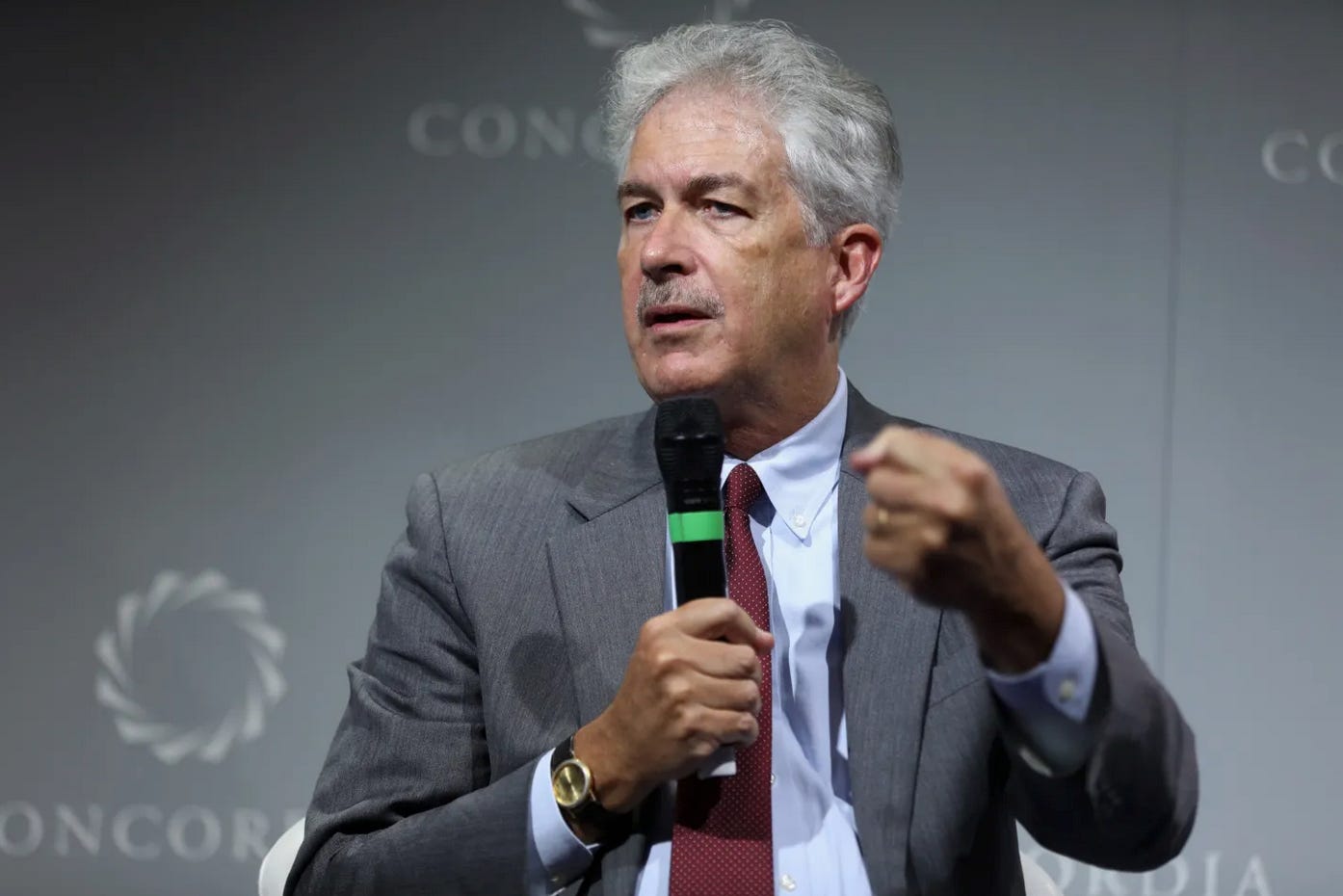
Burns says the US expected the Russians to be far more effective against Ukraine but says they failed basic military manoeuvres because of Putin’s ‘cockiness.’
He attributes this to Putin’s tiny circle of trust, leading to poor vetting of his war plans.
Most interesting is his assessment of what Beijing is thinking about Taiwan, after observing Russia’s invasion of Ukraine, with that war now approaching its fourth year.
‘The one thing the Chinese were not at all polemical about was the war in Ukraine.
They listened carefully. Because they knew they had gotten it wrong before the war started. They thought the Russians would roll right over the Ukrainians,’ he says.
‘I think that honestly had fuelled some of Xi’s doubts about issues such as Taiwan.’
John Bew on UK foreign policy…and Trump
John Bew served as foreign policy advisor in Number 10 to four prime ministers, including most recently for Keir Starmer.
He is one of the UK’s best minds on national security, and his interview with Sam Freedman is essential reading. He gives rich and detailed insights into working in Number 10 and the formation of the various national security strategies that HMG has produced post-Brexit.655

It is difficult to pull out the highlights; there are so many.
His assessment of how to deal with Trump is not only spot on, but clearly the blueprint Starmer is following. And he confirms that the Europeans are quietly preparing for security without the United States.
It is a different presidency. It is highly challenging. But there is something to work with. He feels quite personally about Ukraine, in a way that’s hugely problematic for the UK, but he has affection for the UK, deep affection, which is actually more manifest this time around. He’s got a good functioning relationship with Starmer. I was there for the early setting of that relationship. It is important. And he thinks that NATO increasing defence spending is one of his success stories. It’s not without justification that he can say in the Middle East that his unorthodox approach to diplomacy has yielded more success than there was under Biden. It’s hugely problematic on the Ukraine portfolio. But then there’s still a lot to play for.
But it’s unquestionably a different beast. First time around there were the so-called adults in the room, even if there was a lot of churn. Jim Mattis talking about the rules-based order being the greatest gift of the greatest generation. Gary Cohn and HR McMaster saying America first does not mean America alone. You could orient yourself around that.
This time around it’s harder to orient yourself around a particular faction or grouping. The head of policy planning is gone already, Michael Anton, who was regarded as the Trump intellectual, though his hand is on the national security strategy. The National Security team in the White House is much smaller. In the Biden White House the NSA was massive, hundreds and hundreds of people. So you’ve got more confusion about who’s doing what, as you have seen with what’s going on with the Ukraine negotiations (Kellogg to Witkoff to Rubio to Kushner).
…
Ukraine needs the UK, the proper allies, to stay in the fight and play with whatever ground there is. There’s room for sharp, effective diplomacy. It’s more radical, it’s more combustible. It sticks in the craw. However, we’ve learned some useful habits. Why should we have commentary on every US domestic political issue when we don’t on Chinese and Indian ones. For the sake of diplomacy, do we need to respond every time JD Vance says something about our free speech? No, we don’t.
…
What’s tangibly different now is the Trump administration approach in Ukraine, which changes the conversations that are being had privately between Paris and Berlin and London. In particular, those between Berlin and London right now are of greater consequence than they were when the Biden administration had a relative constancy and transparency about its approach. Secondly, though all three countries are careful about wishing away American support and flouncing around about the future Europe without America, there’s more behind-the-scenes planning in place for what you might call an orderly transition from a dominant American security umbrella.
There are lots of areas where the substance of what the UK-EU relationship should look like hasn’t been worked out.

UK floats banning X
Is the Starmer government taking a page out of Trump’s only playbook and serving it up to Elon Musk?
Over Christmas, a disturbing trend took hold on the social media network formerly known as Twitter, but now X following Musk’s takeover. Musk’s algorithm promotes MAGA influencers, Trump content, populist narratives, loads and loads of AI-generated fake imagery, pornography and his pet project - Grok.
Grok is an AI bot that users can ask to perform certain functions, like searching, fact-checking, and querying information, posts or their authors.
But in recent weeks, it has started digitally undressing women. Men have been asking Grok to alter images posted by women to make them wear bikinis, fewer clothes, undress them completely and a bunch of other awful things.

Musk appeared to agree that this wasn’t an appropriate technology. But his response was not to get rid of it, but limit it to paying users instead of allowing it to be free-to-all. Yes, you read that right. He wants to monetise men being able to sexually harass women online.
It has taken governments a while to react. Interestingly, India was one of the first to complain to X. But today, the UK government has said that it will support a ban on X in the UK if it is recommended by the regulator, which has demanded action from Musk.
Liz Kendall, the technology secretary, promised on Friday that ministers were looking seriously at the possibility of access to X being barred in the UK.
Kendall said she expected Ofcom, which said this week that it was seeking urgent answers from the platform, to announce action within ‘days not weeks’.
‘X needs to get a grip and get this material down,’ she said. ‘And I would remind them that in the Online Safety Act, there are backstop powers to block access to services if they refuse to comply with the law for people in the UK. And if Ofcom decides to use those powers, they would have the full backing of the government.’
In a statement, Ofcom said it had contacted X on Monday and set a ‘firm deadline’ of Friday for the site to explain itself, adding: ‘We’re now undertaking an expedited assessment as a matter of urgency and will provide further updates shortly.’
Under the Online Safety Act the regulator can compel platforms to tackle such material and issue multimillion-pound fines for lack of compliance, with the ultimate sanction being a court order for web providers to block a site or app altogether.
X has been approached for comment. Musk has previously insisted, ‘anyone using Grok to make illegal content will suffer the same consequences as if they uploaded illegal content’.
Musk responded to an X user’s post about the UK government’s threat, saying: ‘They want any excuse for censorship.’
Alcohol a recommended social lubricant
There are times when you can see the sense and logic of what the Trump Administration is doing, or at the very least, the environment which fuelled their platform and victory.
RFJ Jnr’s war on ultra-processed foods is one of those. Railing against America’s obesity and health-care crisis, he recommended a diet of prioritising protein, dairy, healthy fats, vegetables, fruit and whole grains.
All fine.
But then it came to alcohol. The new guidelines dropped advice that women limit drinks to one per day and men two.

Dr Oz, the television presenter whom Trump hired to run the Centres for Medicare & Medicaid Services, was asked for the data to support that particular recommendation. He gave a … shall we say, unscientific response.
‘Alcohol is a social lubricant that brings people together. In the best-case scenario, I don’t think you should drink alcohol, but it does allow people an excuse to bond and socialise, and there’s probably nothing healthier than having a good time with friends in a safe way.”
‘If you look at the blue zones, for example, around the world where people live the longest, alcohol is sometimes part of their diet. Again, small amounts taken very judiciously and usually in a celebratory fashion. So there is alcohol on these dietary guidelines, but the implication is don’t have it for breakfast. This should be something done in a small amount, hopefully in some kind of an event that may have alcohol at it.’
‘But the general move away from two glasses for men, one glass for women. There was never really good data to support that quantity of alcohol consumption. That data was probably primarily confused with broader data about social connectedness.’
Make America drunk, socially-lubricated Again!
And that’s my list for this week.
📻 This week, I joined Emma Nelson on Monocle Radio’s The Globalist to discuss the news…and Venezuela.
Please do send me anything that’s caught your eye, I enjoy knowing what you’ve been reading.