Trump dismayed at allies over Iran, threatens NATO again
The US President says he is surprised European leaders aren't eager to join his war
Donald Trump has once again undermined NATO, conflating the defensive alliance with his expectation that Allies should write the United States a blank cheque for its military ‘excursion’ in Iran.
The US President hit out at his new favourite target, Prime Minister Keir Starmer, saying the UK was once the ‘Rolls-Royce’ of allies.
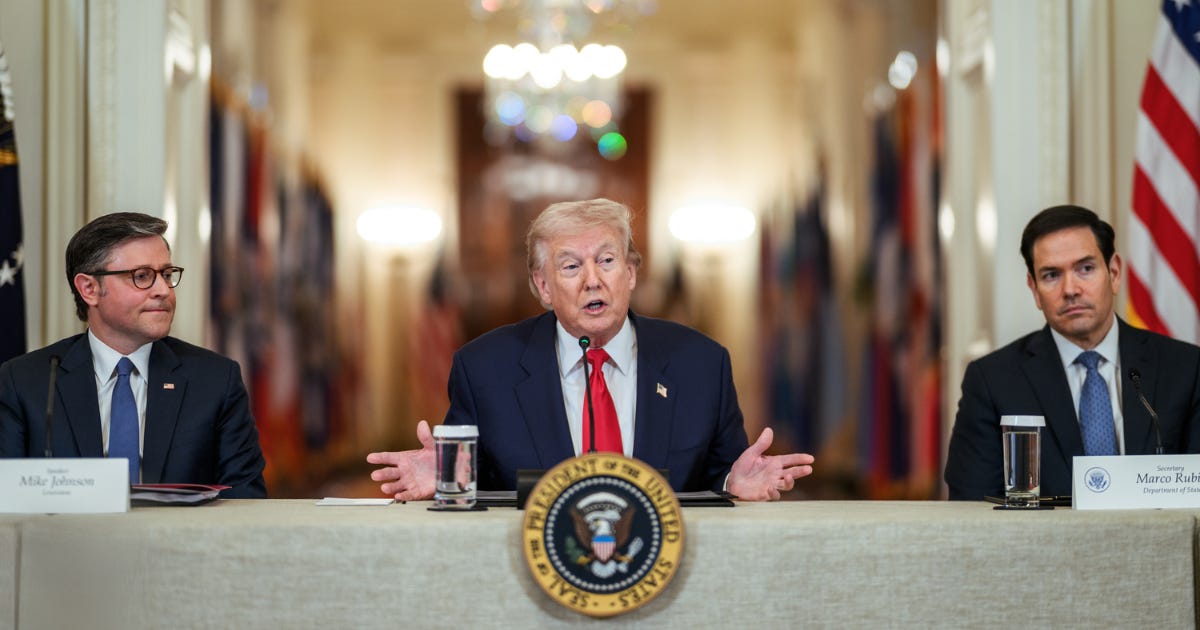
And in a series of media appearances on Monday, he seized on European reticence to back his war against Iran and send warships to reopen the Strait of Hormuz as another reason to question US support for NATO.

Starmer told a news conference that he would not let the UK be drawn into a wider Middle Eastern war, and that his initial judgment to oppose the US and Israel’s strikes on Iran would be vindicated.
‘My leadership is about standing firm for the British interest, no matter the pressure, and I believe that time will show we have the right approach,’ Starmer told reporters at Downing Street.
The UK has been slow to respond to the conflict, only sending a warship, HMS Dragon, last week. The Ministry of Defence has sent minesweeper capabilities. Trump wants Europeans, as well as Japan and China, to send warships to help tankers carrying oil pass through the Iranian-controlled and all-but-closed Strait of Hormuz.
The passageway is a vital export route for 20 per cent of the world’s oil and other critical supplies from the region, such as fertiliser and helium.
Trump insists he has won his war with Iran, now into its third week, but says allies should send warships to help reopen the route.
Starmer has kept more of an open mind than is being reported.
‘There have been discussions in relation to a viable plan, we want to make sure that that involves as many partners as possible, that’s been our stated objective here, particularly talking to European partners, inevitably talking to Gulf partners and to the US,’ Sir Keir said.
‘Because we need a credible, viable plan, this is, to say the least, not easy. It is not straightforward, it is difficult, there is no hiding that.’
Trump said that Starmer was a ‘nice man’ but was unhappy with his decisions.
‘I said it would be really helpful if you would send over a couple of ships, and if you have some minesweepers, which they do, it would be very helpful,’ Mr Trump told reporters in the Oval Office.
‘He said: “Well, I’d like to ask my team”. I said, ‘You don’t have to worry about a team. If you’re the prime minister, you can make a decision. So it’s very disappointing.’
Mr Trump previously told the UK not to worry about sending warships two weeks late, as they were no longer needed because of his military successes.
Yet despite his self-professed triumphs, he resorted to his well-used trope that NATO allies would not defend America if attacked.
‘We spend trillions and trillions of dollars on NATO to defend other countries … we’re going to have to start thinking more wisely in this country,’ Mr Trump said.
This is a dangerous conflation. NATO is a defensive alliance that pledges to treat an attack on any member state as an attack on all. The mutual defence clause, Article 5, has only ever been activated once — by the Americans after September 11.
Trump lamented the lack of eagerness from European leaders to join his war.
‘Some are very enthusiastic about it, and some aren’t. Some are countries that we’ve helped for many, many years. We’ve protected them from horrible outside sources, and they weren’t that enthusiastic. And the level of enthusiasm matters to me,’ Trump said at an earlier event.
But having previously denigrated the role of allied deaths in that war, saying they did not fight on the frontline, and threatened to invade Greenland, which is administered by NATO ally Denmark, Trump and his MAGA-enablers have only themselves to blame.
Jim Townsend was the Pentagon official heading the NATO office in the early 2000s as the US was mulling whether to ask for allied involvement in Afghanistan or not.
‘Don Rumsfeld, the Secretary of Defence at the time, sent a note down that landed on my desk, that said, I don’t wanna see a NATO flag in Kabul and then a week later, another note came down, it said, could you please tell our ambassador to see if NATO could get involved and running what became known as ISAF – International Security Assistance Force,’ Townsend told the Latika Takes podcast during an interview in Washington DC.
Asked if Mr Trump’s behaviour would make it harder next time the request came into NATO, Mr Townsend said the days of the US enjoying the “benefit of the doubt” were over.
‘There was such confidence in us, such trust in us that if we came in and said, we think we need to do something, not that they would immediately say, okay, we’ll follow you into danger, it was, everyone gave a very serious consideration and usually took action within a couple of days,’ he said.
‘What’s changed now is I think the Allies will sit there and listen to this and then go back to their capitals and ask their prime ministers and others, what do you want to do? The Americans they wanna do X, Y, and Z, and should we do this?
‘And so that hurts the alliance in terms of the leader of the alliance being second-guessed, or even third-guessed, because they don’t know if they could trust the view of what the administration is saying, because they don’t trust the president.
‘And that’s just never happened before.’
Trump’s request for help in the Strait of Hormuz is not an Article 5 situation. This was a US war of choice. But his expectation that the Allies would be obliged to help is an extension of America First thinking — the US uses its military and economic superpower status to protect and secure common goods, such as shipping routes, that benefit more countries than just the US.
But his destructionist methods may have worked to get the Europeans to lift their defence spending, but it has had costs.
His weekend call for the Europeans to help him reopen the Strait of Hormuz after his Administration relaxed oil sanctions on Russia, which illegally invaded Ukraine in 2022 and has been menacing European states with drones and sabotage attacks, was a bridge too far.
‘What does Donald Trump expect a handful or two handfuls of European frigates to do in the Strait of Hormuz that the powerful US Navy cannot do?’ German Defence Minister Boris Pistorius said in Berlin. ‘This is not our war; we have not started it.’
Stefan Korneilius, who serves as spokesman to the German Chancellor Friedrich Merz, went further and said it had ‘nothing to do with NATO.’
‘Neither the United States nor Israel consulted us before the war, and ... Washington explicitly stated at the outset of the war that European assistance was neither necessary nor desired,’ he said.
At a meeting of the EU foreign ministers, there was no desire to extend the EU’s existing naval operation in the Red Sea to fight the Houthis to the Gulf.
‘The discussion on whether we are also extending this mandate to cover the Strait of Hormuz, there was no appetite from the member states to do that, nobody wants to go actively in this war,’ the EU’s foreign policy chief Kaja Kallas said after a meeting of EU foreign ministers in Brussels.
‘This is not Europe’s war, but Europe’s interests are at stake,’ she added.
Europe would be wiser to return serve on Trump and demand a transaction, action in the Gulf in exchange for US pressure on Russia’s Vladimir Putin to exit Ukraine.
That would be their best demonstration of grasping the new world order of Realpolitik in which they now live.
This is an updated version of an article first published by The Nightly


