

Australia is reeling after the horrific attack on Helen Haines MP. Haines, 65, was allegedly rammed multiple times by a 43-year-old Brendan Nugent who was driving a Toyota Land Cruiser.
Haines was at the boot of her own car outside her electorate office at the time. Local business owners who witnessed the attack rushed to her aid and performed a citizen’s arrest on Nugent, who is now charged. Just like after the Bondi attack, it is the everyday bravery that has stood out.
Haines’ husband of 40 years, Phil, also spoke to the media alongside the Governor-General Sam Mostyn. Both shone and led the tone for the national response. Phil Haines showed an incredible level of bravery and stoicism as he spoke of his wife’s legs both being amputated and urging well-wishers to channel their thoughts into fundraising rather than flowers.
‘The two most important parts of Helen for us as a family is her heart and her mind. Her heart is huge. And her mind - she has the sharpest intellect,’ he said.
‘We are thankful and grateful that at this stage her heart and her mind are in good shape.’
Mostyn called on the community to ask itself how it had lost its 'great skill of disagreeing well and with decency to each other.’ Nugent’s motives are unclear, and mental health issues are clearly being examined; he had posted pro-Hamas and extreme left content on social media.
As the news broke on Monday morning UK time, there was a sense of dread and horror. After Bondi, it feels that Australia’s innocence is well and truly shattered. The things that never used to happen in Australia, including political violence, are starting to happen.
And it carried a terrible echo of 2016, the year I moved to the UK, and the horrifying assassination of Jo Cox, the Labour MP who was stabbed to death by a man sympathising with far-right ideology in her constituency while she was meeting voters.
Political violence in the UK has been recurring with the assassination of David Amess MP by an Islamic State supporter in 2021 and the alleged murder of Reform supporter and former Tory Minister Ann Widdecombe this year.
After Jo’s death, her husband and father of their two children Brendan Cox established More in Common, an NGO which conducts research and helps devise policy aimed at healing social polarisation.
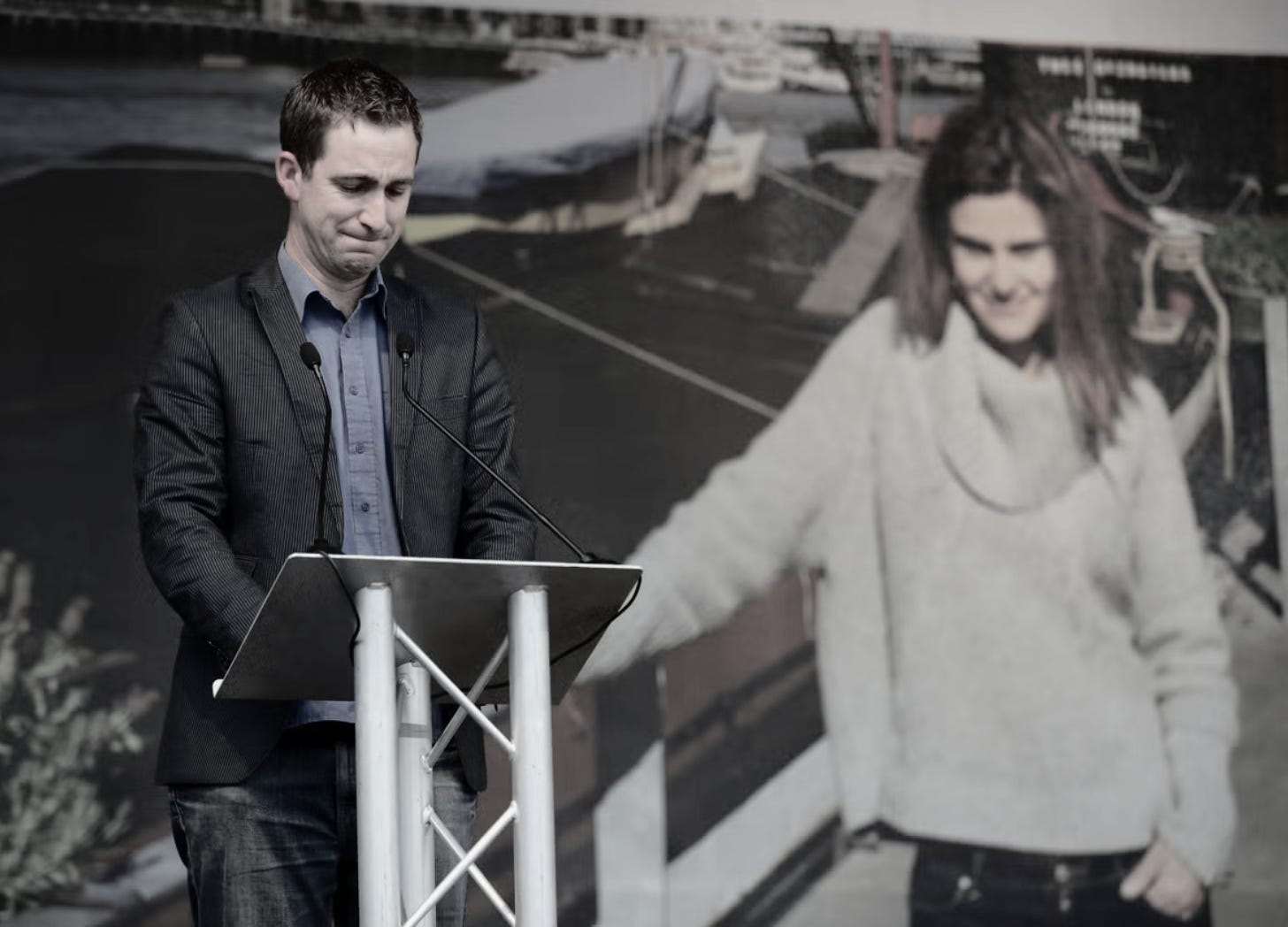
I spoke with him about the attack on Helen Haines and below is a lightly edited transcript of our discussion.
Latika M Bourke (LMB): Brendan, I saw your tweet. You came out of a long meeting, you said, to see that news. Can you tell me about how you heard the news, your feelings and reaction to it?
Brendan Cox (BC): I had actually been in an all-day meeting in a basement in Cambridge about the growing anti-semitism problem in the UK and how we can build a coalition to address it. And I’d encouraged people at the beginning of the day to turn their phones off so that we could have a proper sort of deep conversation — the substance of the conversation deserved that.
And therefore, it was only during a late afternoon break when I came outside to check my phone that I then had lots of messages from friends saying, ‘I hope you’re okay, I’ve seen the news, hope you’re okay,’ which is always bad news.
I get those messages from time to time when something awful happens. So I clicked across to BBC News to see what it was, and obviously the story was what happened to Helen.
I think I’d describe it as a punch to the guts, that sense of just profound sorrow, of remembered pain, of present concern, hope that she might be okay and the fear that she might not be.
And obviously it all replays all of the… because it’s so similar.
I know nothing about Helen other than what I’ve read in the last day or so, but from what it sounds like, actually, completely similar to Jo, in terms of both where it happened, obviously not literally. But in terms of it wasn’t the corridors of power; it was back in the constituency, in your home, where you feel safe, and you should be able to feel safe meeting with constituents.
It sounds like Helen is incredibly focused on her community first; Jo was very similar, and Jo’s first name is Helen, so there’s a weird sense of parallels.
And then, of course, you go through all of the pain knowing what her family are experiencing. When I first heard the news, I didn’t know how old she was, whether she had young kids, and so all of that just goes through your head.
LMB: Brendan, I can vouch that she’s exactly like Jo in that, just like a really gentle person who is the least likely — and not saying any violence against anyone is okay, obviously — but you can see why some people might be targeted. Jo and I think Helen share this trait of being completely unremarkable in that sense; they were kind of very pastoral. It’s weird to me.
BC: Yeah, no, I agree. I’m not in Australia; I don’t know Australia well, but what I have seen, it feels like a reaction to it; the scale of the shock is partly driven by that, because again, similar to the scale of shock in the UK when Jo was killed, this sense of ‘What the hell, what the hell is this? This is not who we are.’
LMB: Yes. Yes. Brendan, you mentioned how you know you hear of all these messages, your friends texting you, that must be happening an awful lot to you because we have had so many political assassinations and attempts in the UK and elsewhere in the world. And now, in the unlikeliest place, in country Australia.
What is your sense of when you see these messages just coming at you all the time, way too often?
BC: Yeah, each time I get a barrage of messages, it fills me with a sort of dread of what the f*** has happened there. And the key to understanding exactly what that family will be going through, some of it’s quite granular in terms of who will tell; do they have children to tell? Will there be a moment of hope before the realisation of the scale of it, all those kinds of things.
And then, of course, the macro political situation, which is: how are democracies ending up in a place where this kind of violence - it’s not daily, thank God, I mean, the threats are daily, but the actual attacks feel like they are increasing in their regularity. How have we built a society where that is happening, and that’s a deep, longer-term…
The bits where I think we have agency — one of the things when Jo was killed was how disempowering it was; you can’t do anything about it, you can’t make it, right.
And I think similarly, in the case of Helen, it looks like, thank God, she’s going to survive and what a huge relief that is and for her family — the pain and the impact have happened.
The question now, and the thing that Australians do have real control over, is how the country responds to it.
Is this a turning point where people suddenly realise what public service politics is, at its best? The value of it, the need to protect, support and build our democracy, or does it become another sort of accelerant in that sort of violent, increasingly violent culture?
Just a summary of the news — it sounds like the motivation might be quite complicated and unclear — but, even if the motivation for this might have been personal or specific, the sort of culture that accepts this kind of violence and where violence becomes normalised is one that we should all worry about.
Again, I can’t talk about this case because I don’t know it and it might not apply to this case. But the wider pattern of intimidation and a political culture of violence, there are reasons that that is happening.
I think part of that is the online ecosystem that enables, facilitates and drives this kind of normalisation.
I hope that this is a wake-up call. Again, it doesn’t have to be linked to this case, but a moment at which people think, okay, let’s rebuild something.
I think the thing with me in the aftermath of Jo was a realisation, which I probably didn’t have as clearly before, that our democracy isn’t something we should take for granted. It’s not the rock upon which nations are built; it’s a creation, and it requires us to keep building it and to keep nurturing it. And unless we do that, there’s a real risk to it, and I think in recent years, or what we’ve mostly done, is attack our democracies and undermine them, and I think that comes with a real price.
LMB: And what are the solutions? I know you do a lot of work at More in Common on this. I mean, this is a deep and complex problem, as you said, but if there is any advice you can give to just an ordinary person feeling so shocked about this, what is it?
BC: I think there are two things, so I think one: there are a set of policy changes that need to happen, and those might be very tactical things, like reviewing the security of members of parliament, but those are tactical; those are not going to solve this.
It needs to be addressed at the strategic level, and I would say the chief on that list is the information environment and the fact that in Western democracies, we have allowed our information environment to be poisoned by algorithms that incite, facilitate support, and normalise violence and extreme content is totally absurd.
And to be fair to Australia, they’ve led in some of the thinking about this, the ban on social media for under-16-year-olds, that kind of stuff, and I know that there’s a conversation now happening about an algorithm clampdown.
But I would say that the policies that are on the table are a pale imitation of what’s needed to make sure that the information environment doesn’t undermine our democracy. So, in terms of policy, I would say that is very high on the list.
There’s then a much more systemic policy, which is about how you rebuild social connection between people. Often, again, I can’t talk to this individual, but often the people that commit these kinds of attacks are lonely, disconnected. They exist in a society which is increasingly fragmented and doesn’t have the institutions that bring people together. I think the rebuilding of our sense of community connection, it won’t solve these kind of issues overnight, but it’s the underlying vulnerability, which makes people more vulnerable to this kind of extreme action.
And then at a personal level, I think this is an encouragement for people to reach out and be part of strengthening and rebuilding their democracy.
Again, looking at the profile of Helen, I’m sure the way that she would respond is by asking people to reach out to their own representatives and thank them for their service, whether they agree with them or whether they disagree with them.
To volunteer, be in a local political party, no matter which one it is, to get involved in local politics to nurture the civic infrastructure that underpins our democracy, and at the same time, to think about our own individual contribution to political culture.
I think there’s been a big trend again, driven by the algorithmic application, towards a binary interpretation of politics where if you disagree with somebody, they’re evil, racist or stupid, or whatever else.
And I think actually finding new ways of having deeper connections and conversations with people that you disagree with is really important.
So, only after Jo’s murder, we launched something called Britain Talks, with The Mirror newspaper, which is on the left, as you know, and The Express newspaper, which is on the right.
And it matched their readers together to have a conversation about what we’ve got in common.
I think we spend so much of our time talking about our differences; we’re incredibly bad at talking about our commonality, and I think ways of facilitating and building that become even more important in moments like this.
LMB: Political violence in the UK has gotten worse against MPs since Jo’s death; do you think we’re succeeding in that, though?
BC: It’s hard to say. The information environment, the role of hostile states in boosting extremism. There’s a whole series of underlying societal conditions, I guess, which are accelerating and driving that violence.
I think that the work that has happened since Jo’s murder in the UK would have had an impact on that, but it’s swimming against the tide, coming back to the online algorithms, unless we address those structural drivers
We definitely need communities and individuals to provide leadership in the space, but we also need a conducive policy about it.
LMB: And how far would you go on that with an algorithm? What’s your recommendation?
BC: I’m actually doing quite a lot of policy work on this at the moment in the UK.
Obviously, I know the UK context better in terms of what we’ve got in terms of the Online Safety Act; my understanding is that in terms of the Australian process at the moment, there is a live conversation around algorithmic amplification.
I mean, my view is that organisations that are using algorithms to edit, choose, and promote content are publishers; they’re not platforms, and they should be held legally responsible in the same way that publishers should.
And if they don’t want that responsibility, then they shouldn’t be editing; they shouldn’t be making editorial choices.
In terms of the conversation that’s happening at the moment, there’s obviously a conversation about having the ability to turn algorithmic amplification off and having a chronological feed or feed based on your friends – that has to be by default.
People very rarely change their defaults, so I think the emphasis in that should go further and faster, but I also think there’s more needed than that, but those are areas where I’d start.
LMB: Yeah, Sikorski, the Foreign Minister of Poland, a couple of years ago said that algorithms just should be banned, which I think is quite interesting because that is the social media model we all signed up to; originally, it was like, I get to choose who I’m following ….
BC: Totally
LMB: And then it turned into this thing where now you’re getting spewed up all this weird stuff?
BC: Yeah, yeah, yeah, and it’s all pretty clear what the algorithm does. It’s designed to either reinforce your prejudices or make you furious with people who have different views by serving up the most extreme content.
LMB: Yes
BC: So it’s not subtle, but it is carcinogenic to our democracy and our society, and the fact that we have, like a frog in boiling water, just allowed this to happen, I think we’ll look back on this as one of the biggest sort of strategic mistakes, both in terms of our own national security, but also in terms of the health of our society and democracy.
LMB: And just my final question, Brendan, you’re watching this horror show too often. Do you still recommend to people to go into public life?
BC: Yep, every day.
LMB: Do you really?
BC: Yeah, yeah, I think this is how we’ll change things, how we’ll change the policy environment that is talked about. It’s how we get good things done. It’s how we’ll find ourselves out of this crisis now.
I also worry about my friends who are in politics, but if good people stand back, then we know where politics will go. So I don’t downplay the risks; I don’t pretend like those risks don’t exist. But I think in a period of those risks, the importance of the service is compounded.
I think it becomes even more important to step forward and, through the work that we’ve done in Jo’s name, for example, the Jo Cox Leadership Program, the Labour Party has supported and trained hundreds of women into politics.
Again, women tend to get the most abuse, the most threats …
LMB: Yes.
BC: … often the most violence directed against them, but certainly one of Jo’s beliefs was that until we get a Parliament that better reflects the nation, then we’ll continue to create policy that doesn’t serve the nation, and even in the midst of, in the aftermath of what happened to Jo, I think that building and encouraging good people into policies is the best way of getting out this obvious problem.
LMB: Well, I wasn’t sure how you’d answer that question, but I wasn’t expecting that answer. Thank you for giving me so much of your time. I know you’re a busy guy. I really appreciate it.
You can read the news report I published from this interview in The Nightly here.