EU beauty: von der Leyen's trade trifecta
The European Commission President said the deal with Australia was 'hitting it for six'.
On one side of the Atlantic, trade is a dirty word; on the other, it is the definition of a revitalised European Union.
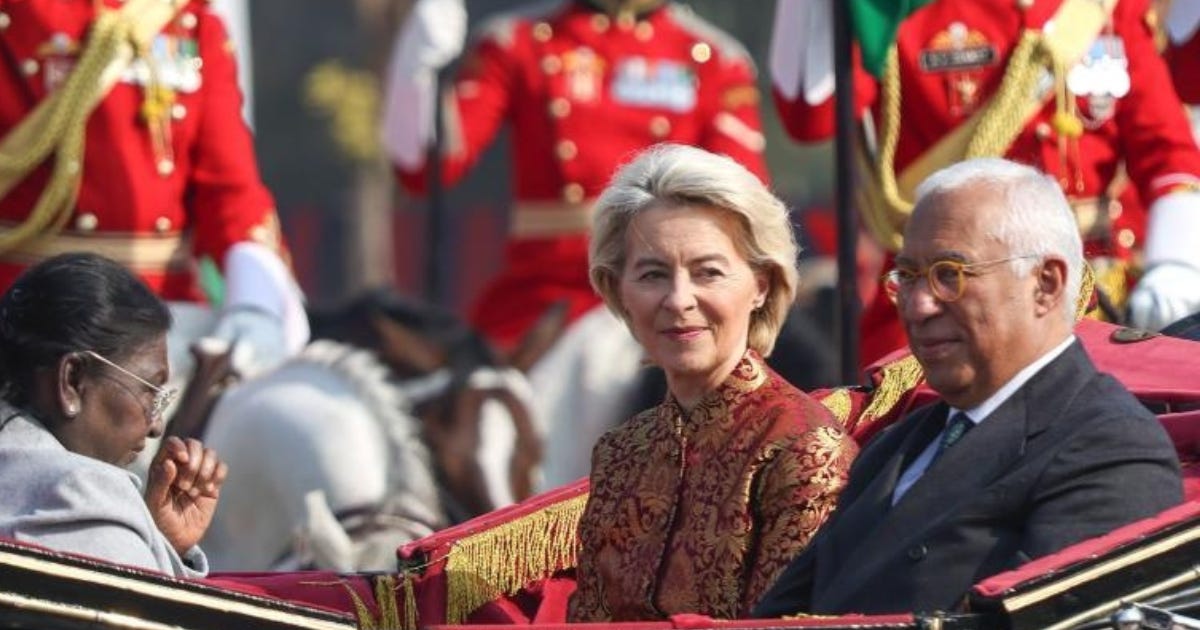
After signing Mercosur last year and landing a major trade and security deal with India in New Delhi in January, the European Commission President Ursula von der Leyen this week landed a trifecta.
In Canberra on Tuesday, the President and Australia’s Prime Minister Anthony Albanese signed not just a standard trade deal, which in and of itself would be a huge moment, but a supersized security and research partnership that eliminated 99 per cent of tarrifs, gives Europe favourable access to Australia’s increasingly-sought-after critical minerals, enables Australian defence companies to co-buy and produce weapons, plus grants Australia entry to Europe’s prized Horizon research programme.
‘I am so proud that we got this done,’ von der Leyen told a joint session of the parliament.
‘Because it is a fair deal, and one that delivers for your businesses and one that delivers for ours.
‘I think you call that: “hitting it for six.” A trade deal many thought we might never land. But this reflects Europe's changing approach.
‘From Latin America to India, and I am so pleased to add, Australia — when it comes to trade, Europe is open for business. We are rearming. We are decarbonising. We are preparing.
‘We are becoming an independent Europe. And this means a more outward Europe. And this is why I am here today. Because showing up matters.’
von der Leyen said Australia completed a ‘trade trilogy’. It is remarkable progress from the Europeans. Their deal with India removes €4 billion of tariffs on 97 per cent of goods it exports to the world’s most populous nation. With the Mercosur countries Argentina, Brazil, Paraguay, Uruguay and soon Bolivia, it ended a quarter-of-a-century of stalemate to create one of the world’s largest trading zones of 700 million people.
Trade talks between Australia and the EU date back more than a decade. The negotiations have been excruciating to watch as both sides repeatedly caved in to their farming lobbies.
Australia, which does not subsidise its farmers, always had a moral upper hand on this point and was not afraid to play it.
In 2023, the Australian Trade Minister Don Farrell walked out on the talks just as they were about to be finalised, demanding that Europe allow several tens of thousands of beef into the Union tariff-free.
It made for a cool affair when the minister finally met the President, at Sydney’s Admiralty House on Monday.
‘The President, when I greeted her, said “ah, you’re Don Farrell” as if to say maybe I’ve been the person who has been the impediment to getting the agreement,’ Senator Farrell told me in an interview with his EU counterpart Maroš Šefčovič from the Canberra restaurant Molto on Monday night.
He objected when it was pointed out that the President had a point.
‘Well, I didn’t exactly walk out but that could be an interpretation; we just didn’t reach agreement at that time,’ he said.
In the end, Australia settled for a quota of 30,000 tonnes of beef that will be phased in incredibly slowly and limited to grass-fed cows. Had Australia struck before the Europeans agreed Mercosur, they might have achieved more. And the figure is well short of the 50,000 farmers wanted, and a genuinely free-trading Europe should have had no problem permitting.
Hamish McIntyre from Australia’s National Farmers Federation said the number represented ‘no material change’ from what the Australian government ‘rightly rejected’ in October 2023. The opposition has taken their side and this could be an issue in the parliament when the agreement comes before it for ratification.
Ultimately, for both Europe and Australia, political realities prevailed in a way they never had before.
So what has changed? The answer is two-fold.
Albanese and von der Leyen are political rare species on the global stage, having both defeated the post-pandemic anti-incumbency curse that killed off numerous political leaders.
Meaning both are trying to navigate Trump’s world order together.
‘The world we live in is brutal, harsh and unforgiving. It feels upside down. What we knew as certainties are in question. The comfort blanket of yesterday is ripped away,’ von der Leyen told the Parliament.
Europe has borne the brunt of the Trump Administration’s approach to trade and security, and is battling the MAGA movement’s open attempts to engineer populist political victories in national elections.
On the Australian side, Trump’s Liberation Day tariffs landed smack-bang in the middle of the election campaign. That day, Farrell picked up the phone and rang Brussels. Much had changed in the Berlaymont, too. Ursula von der Leyen had won a second term or mandate and had replaced Valdis Dombrovkis in the trade portfolio with the charismatic Slovak in Šefčovič. They spoke for 60 minutes.
Farrell struck up an immediate connection with Šefčovič, the kind that had eluded him with Dombrovkis. There was a new hope, pending the election outcome in Australia.
After his victory, Albanese, with 94 seats under his belt had a unique ability to deploy the benefits of incumbency at the same time as seeking a fresh approach to European relations.
‘It helps the re-election of both of us to our respective positions,’ he said at his joint press conference with von der Leyen.
‘What we haven't done is start again. What we've had is a consistent government in Australia with one trade minister, one Prime Minister, and in the European Union under the leadership of the President. You've also had a capacity to make sure that we deliver.’
‘The the two of us decided, I think it was one and a half year ago, it cannot be that we cannot bring this free trade agreement that is so close to be finished over the finish line. And it needed the political push,’ von der Leyen said.
Also known as risk-taking — something more challenging for Albanese, who specialises in politics by incrementalism. But with a disintintegrated opposition, he stepped out of his comfort zone, stared down the meat lobby, who are not traditional Labor voters, and put his 94 seats to work.
As I previously reported, the deal would include better trading arragements, security and defence cooperation with access to the EU’s remarment funding but at the last minute also included access to Horizon.
Gunnar Weigand was managed the Asia-Pacific department at the EU’s EEAS or foreign office equivalent, between 2016 and 2023.
‘The geopolitical situation has radically changed since the EU-Australia FTA negotiations failed in October 2023. Both partners are confronted with economic coercion from their major trading partners, China and the US,’ he told Latika Takes.
‘With this happening, both partners send a strong signal to Beijing and to Washington DC: rather than becoming a battleground of their strategic rivalry they take the initiative to diversify by strenghtening economic and security links among likeminded partners, thius contributing to what PM Carney coined as the “alliances of middle powers.”
‘The EU and Australia are thus creating together new opportunities for both sides through trade liberalisation and increased joint economic security as opposed to unilateral protectionism and economic coercion.’
Laughably, Europe’s farmers decided to respond to Australia’s objections with a case of hold my beer (or champagne!)
‘The significant concessions on highly sensitive agricultural sectors-particularly beef, sheep meat, sugar and rice have long drawn strong opposition and concern from the farming community,’ Copa cogeca, the European farming lobby group said in a statement
‘In a post-Mercosur context, the cumulative impact of successive trade agreements makes these concessions unacceptable. Even for a traditionally more offensive sector like wine, the potential benefits of this agreement remain elusive, with Australian exporters likely to see more benefits due to the elimination of duties.’
Whether the farming lobby can convince enough Members of the European Parliament to vote against the deal, as they effectively did with Mercosur is now the next question.
And it is another test of French President Emmanuel Macron who talks about Europe and French strategic autonomy but furiously opposes any concessions on allowing Europeans to eat more non-European meat even when wider economic, security and strategic benefits stand are on offer.
Members of the European Parliament from the French-led protectionist bloc, including Ireland and Poland, helped delay the implementation of the EU’s recently signed Mercosur deal by as much as two years by sending it to the courts for a legal check. The Commission will provisionally enforce it in the interim.
In her speech to the Australian parliament, von der Leyen said that last year, for the first time every single member state ran a trade deficit with China, which has practiced economic coercion against Australia and the European member state Lithuania (and continues to supply Russia’s war against Ukraine).
In 2023, she set out a strategy to ‘derisk’ from dangerous dependencies i.e China (but citing Europe’s thirst for Russian gas), but judging by last year’s trade figures, this is having little success. This is why she pointed out to the Australians (whose economy is dependent on China) that diversification remains a necessity.
Ironically, China and Trump may be the making of Europe, turning it into the quasi-trading, rather than regulatory power, ten years after Britain left the bloc claiming it would be free to land better trade deals.
Agriculture grab the headlines, but the security partnerships have the potential to unlock enormous benefits for the smaller signatory countries.
In May last year, the European Commission opened up a €150 billion loan scheme for member states under a program called Security Action for Europe (SAFE).
These loans are available to member states wanting to rearm (per the new 3.5 per cent NATO spending targets), but no more than 35 per cent of components can come from outside the EU.
But countries outside the EU that have signed security deals can join member states in buying new weapons together, and there is also the option of bilateral or even multiple-country groupings getting together to procure together.
The program was oversubscribed with 19 of the EU’s 27 member states signing up.
Note how many smaller states were in the initial list. But the immense benefits for Europe’s security partners don’t stop there.
Last year, I interviewed the EU Commission’s first-ever Commissioner for Defence and Space, Andrius Kubilius. The Lithuanian told me that one clear illustration of the scheme’s potential was the ability for a band of smaller states to use their combined buying power to take out bigger contracts.
‘If countries are going for joint procurement, it means that the contract is much larger, then because of larger contracts, you can expect lower prices,’ he said.
Further, an Australian (or any country that has signed a security deal) could be treated as a European one under Commission exemptions, meaning the 35 per cent component rule would be waived.
This would essentially create mini free-trade zones for weapons such as missiles, artillery systems, drones, anti-drone systems, cyber capabilities and more. Imagine a world where Indo-Pacific Quad countries like Japan, Australia and India all teamed up with not the US, but Europe and possibly with Ukraine to buy and make new weapons together.
Kubilius deftly stressed that the EU would be a ‘reliable’ partner under any arrangement struck.
Brussels get a bad wrap, especially in post-Brexit Britain, but with this hattrick, it is the EU bureaucrats showing the rest of us what the Art of a real Deal looks like.


