Andy Burnham is having a good run. This week Labour faced two by-elections and won both.
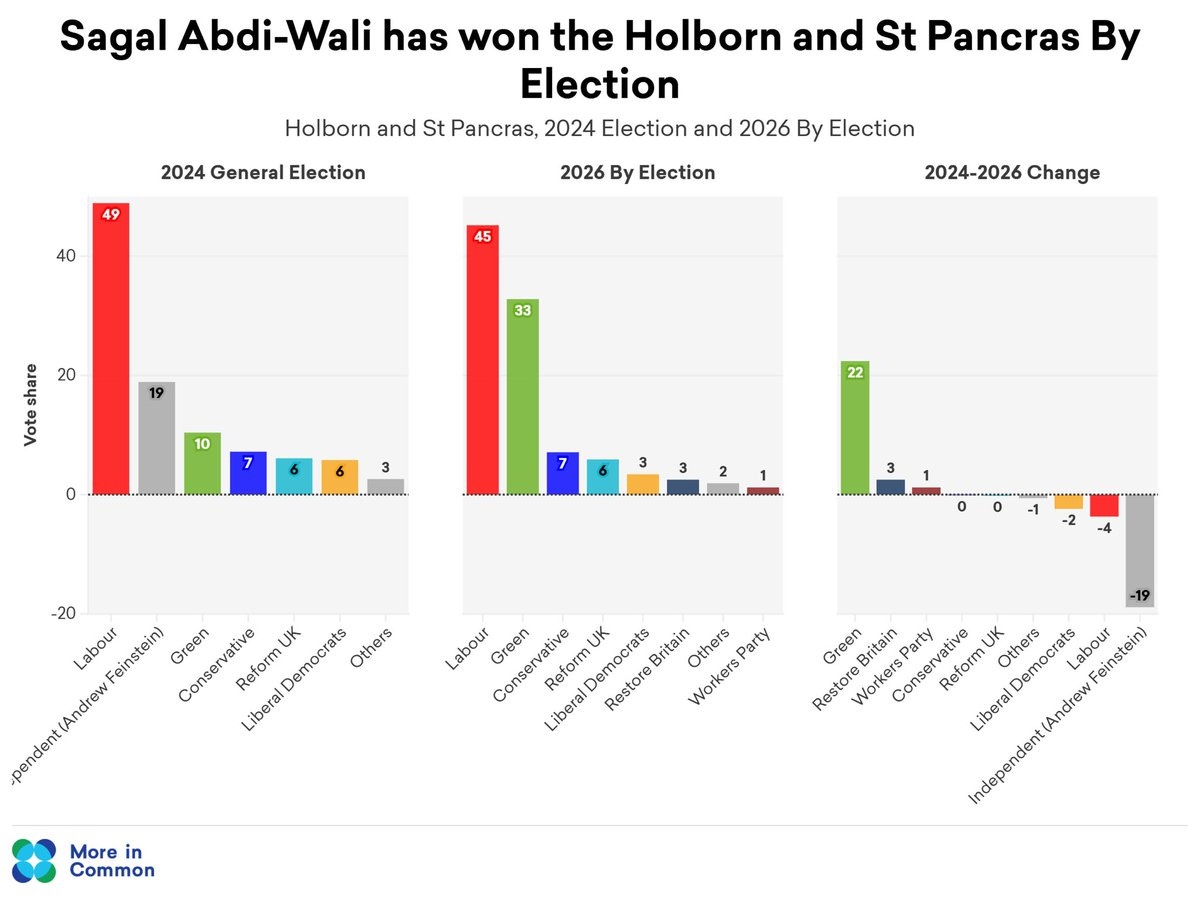
This first is one Labour should not have lost — Keir Starmer’s north London seat of Holborn and St Pancras.
Sir Keir won the seat in 2024 with a reduced majority from 27,763 to 11,572 after a boundary change. But he also lost votes to a Gaza independent candidate. The former prime minister quit the House of Commons after his party all but knifed him earlier this year.
Their brutal decision to install Burnham is starting to look like it is paying dividends.
In 2026, the threat to Labour was not from the Gaza independents who caused an upset in the 2024 election, but from the Greens, who have been experiencing a brief breakthrough under leader Zack Polanski.
Polanski decided to fight in Holborn and St Pancras, effectively turning it into a quasi-referendum on his own leadership.
He conceded defeat before the result was officially announced for Labour, which won 45 per cent of the vote (Britain has a first-past-the-post system) compared to the Greens’ 33 per cent.
Polanski said he had tripled the Greens’ vote, and effectively reduced Labour’s once whopping majority to 3364. He is right. But this is just a by-election; the real margin will be reestablished at the next general election.
If Polanski was going to capitalise on the Greens’ resurgence, his time was now, and the well-educated seat was the place to put it to the test. Additionally, by-elections are traditionally an opportunity to give the middle finger to a poorly performing government, but Labour voters stood by their party.
‘Governing parties usually get hit hard in by-elections,’ said More in Common’s pollster Luke Tryl.
‘But the drop in Holborn was below the average for defending a seat of by-elections in any post-war parliament.’
Polanski told the BBC that voters told him they wanted to ‘give Andy Burnham a chance.’
But the Greens themselves may also be the problem. Last week at their party conference, a motion declaring that Zionism is racism was passed. Polanski did not approve it and has now said he opposes it. But it is too late.
Mainstream Greens, like the human rights campaigner Peter Tatchell, are as repulsed as the rest of the public by the blatant anti-semitism.
‘It could lose the Greens public support, undermining the decades of hard work that many of us did to create an effective, credible progressive party,’ Tatchell warned, in an article I wrote for The Nightly earlier this week.
Further north, in Newcastle-under-Lyme, there is also evidence that voters are willing to give the new guy a go.
Previously, voters in the constituency backed Boris Johnson in the 2019 Conservative landslide and also backed Brexit, so it makes a good case study for gauging the national mood.
In a council by-election held this week, Labour won a seat from Reform (in a Labour ward), recording a whopping 18 per cent swing. Reform lost only 0.4 per cent of its vote, but the Greens lost 9 per cent, and the Tories and Liberal Democrats each lost 4 per cent, meaning Labour attracted centrist Conservatives as well as its left-wing supporters back.
There is no doubt that Labour is re-energised. As the party conference season comes to a close, Reform’s was a forgettable affair overshadowed by the Channel 4 sting on donations, and the Greens was polluted by anti-semitism.
Labor against that pretty much dazzled. Of course, Burnham will need to meet expectations. But in a speech to the Innovation Nation Summit on Friday, he targeted yet another ambition to add to his bulging list — to make the UK the world’s leading innovation nation.
In my ten years of living here, it is my observation that the UK has become a deeply unambitious country and overcompensates with nostalgia politics that hark back to the days when its military and fiscal might made it a genuine power.
Brexit is a case in point. The Brexiteers’ boast was that leaving the EU would enable it to adopt a ‘Global Britain’ posture and ‘tilt’ to the Indo-Pacific. But with what and how? A hollowed-out military and low-growth economy? Both are now removed from the lexicon.
What has stood out to me over the last decade, compared to my experiences growing up in Australia, was how little Britons were told to strive to be anything, and that the government’s role was to enable them to achieve their goals, as long as the hard work was put in.
Former UK Prime Minister Gordon Brown with Prime Minister Andy Burnham. Photo: Number 10
I had expected to hear it from the Britain Booster Boris and perhaps the technologically-minded Rishi Sunak but never really did. The last person I expected to hear this from was Burnham.
‘Re-industrialisation, that is a serious part of this mission and re-industrialisation that is felt by all people in all places. We can do it and we can be the nation in the next 10 years that as Gordon (Brown) says, does find the cure for cancer or does make the breakthrough on dementia or indeed on nuclear fusion,’ he said.
‘To anyone who says we can’t be that I say we did it before, so why not?”
‘We’ve got the assets, we’ve got the talent, we’ve got the ideas and the ambition, but here’s the crux of it. Here is where we’re falling short. We are not making the most of them yet. And this is our collective challenge, everybody. This is what we must fix, and this is what today is about.
‘If you create a situation where people have the power to set a mission, it’s unbelievable and then people start to feel part of it and start to come towards it.
‘And that’s what I want everybody to be able to do, all parts of the country, to set new ambitions for themselves. And you can see the results when it happens.’
Boris would blush at all this boosterism. But Burnham is absolutely right to target science, research, fintech, AI and the creative industries as its strengths, and have the state support them — to a degree.
Real powers are fielding their horses in the race for dominance and backing them. Burnham wants to fuse this innovation mission with his plan to grow wealth across the country and outside of London. Innovation funding will go to mayors to dole out.
He also hinted at plans to overhaul the education system to make it less academic and more technical, and said he would ban non-compete clauses that prevent workers from creating their own start-ups for the ‘most promising startups and scaling firms.’
He may run into trouble when he starts insisting UK pension funds invest specifically in British-based companies.
But his intentions are right, and the optimism is a welcome counter to the gloom and doom of the Starmer regime and Farage’s constant anger.
Perhaps the most encouraging part of the speech was when he recounted being sceptical that antivirals, testing and screening could end HIV transmission amongst the young within a decade.
‘I look back at it, and I castigate myself for the caution because the progress has been incredible.
‘And I learned from that and then start to think well how do then we apply that thinking more nationally’
With rhetoric like this, Burnham sets his own bar very high. Maybe too high; it will be a long and hard fall if he does not deliver.
But there is no doubt he deserves the open mind the public appears to be giving him.
Latika Takes is a reader-supported publication. To receive new posts and support my work, consider becoming a free or paid subscriber.