

On the sidelines of the Warsaw Security Forum held this week in Poland, I interviewed Norway’s Defence Minister Tore O. Sandvik.
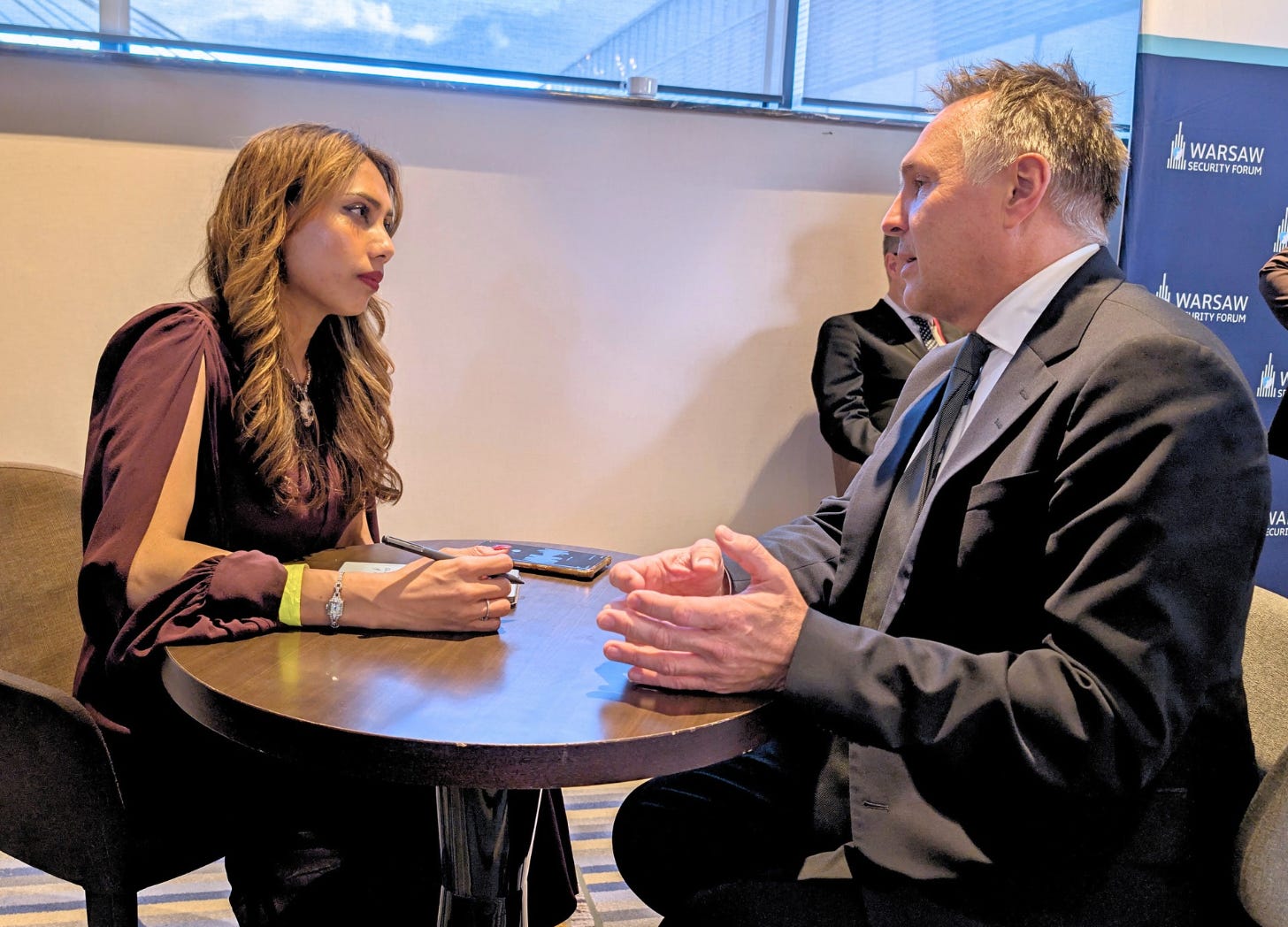
It was only a short time allowed, so I did not get to nearly any, let alone all of my questions, but in the end we managed to canvass some substantial topics, that I hope we can resume in more depth next time.
US President Donald Trump’s diesel deal with Russia’s President Vladimir Putin hung over the conference, as did persistent questions about US commitment to NATO — although publicly, you will see Europeans expressing confidence that the US is a rock-solid ally when it comes to upholding Article Five.
This is where I began my interview with Sandvik. Below is a transcript, which I have lightly edited for brevity.
Latika M Bourke (LMB): You said today on your panel that you think NATO is stronger than ever. But how do you say that when we see constant questioning and undermining of Article Five from the US?
Norwegian Defence Minister, Tore O. Sandvik (TS): Well, I don’t see that Article Five is under pressure. We had this meeting in Ankara; we can see what the Americans are doing — also, with the President in the room. I was a part of that Summit as well; I was in the room and there’s full support for Article 5; it’s an ironclad support for Article 5.
And that’s also in the documents. And the documents are what’s developing NATO. So I don’t doubt about Article 5, and I think also SACEUR (Supreme Allied Commander Europe Alexus G. Grynkewich) was pretty clear today that NATO is threatening no one, but if we are going to be attacked, we will have a formidable answer on that.
LMB: And who would lead?
TS: NATO, together, SACEUR.
LB: But who in NATO do you think would do the leading? If Article 5 really was tested, which countries do you think would be the ones to stand up? Would it be Italy, would it be Portugal?
TS: No, it will be the Command in NATO. The exercises, this is what we’re rehearsing.
Earlier this year we had 30,000 troops in Norway and Finland exercising together under NATO command — how to answer an attack on our soil. So this will function in case of an attack against NATO.
But as the General said, we don’t see any imminent threat of an attack on NATO. We think that Putin is more than enough dealing with Ukraine. He’s not succeeding in Ukraine. What you now can see the threats from Russia in the hybrid sphere because it’s not succeeding.
LMB: But they’re increasingly dangerous and life-threatening; look at Leipzig.

TS: Of course, they’re dangerous. And of course, but we will answer and I also agree with the General who said, I think it was yesterday, we need to be more detailed and concrete about what hybrid threats are.
LMB: Yes
TS: That’s about assassination; that’s about sabotage, infrastructure, that’s cyber attacks, it’s fires and different things.
LMB: And why do you think it’s important we state what it is?
TS: Because for our own population to point out that this is not something blurred, and also because then we can set red lines. And every time that happens, we need to answer because Putin does this to divide us, to split us in the support for Ukraine.
And the answer from us, we will not stop supporting Ukraine. Norway will support Ukraine next year with $8.5 billion dollars.
Germany’s response to the Leipzig episode was to lean in, to spend more in Ukraine, to give them more advanced weapon systems. So the answer is, we will support Ukraine.
LMB: But so far that is not deterring Russia in this particular space; if anything, they’re increasing. So is there more that we have to do? And what is it?
TS: I think we don’t want to escalate. We don’t want a war against Russia.
LMB: No. But should we be doing some of these things back to them? Take out their systems, take down their electricity. Take down their banking?
TS: No, we don’t want to go to war against Russia. We don’t want to influence Russia in that way. We want to support Ukraine. And we have a red line. If Russia tries to attack NATO, the answer will be formidable, and it will be immediate, and it will be also, as SACEUR said, we will win that fast.
So I think Putin knows that we can see that in the north, where they have all the capacities, which Norway is watching 24/7, 365 days a year.
They don’t want to raise the tension because they have enough with the flank they are operating on. So NATO will be strong along all of the flanks on NATO and therefore also that will be a strategic dilemma for Russia.
LMB: Is Trump lifting sanctions on Russian oil, does that undermine NATO’s efforts on Ukraine?
TS: We won’t lift the sanctions. We think it’s - I don’t think we can change Putin’s ambitions, but we can change the calculus.

One of the calculations you have to consider is the economy is going bad. And oil is financing the Russian economy, so we need to sanction Russia.
LMB: So in that light, hasn’t Trump thrown them a lifeline?
TS: We will still sanction; we don’t agree that we should pay Russia for exporting diesel or oil.
We need to weaken the Russian economy. This has to cost for Russia; this has to cost for Putin. We know his economy is really, really bad, and if he stops hitting infrastructure and civilian targets in Ukraine, if he stops killing Ukrainian children, if Putin stops killing children, the war is over, if he stops …
LMB: But you’re not answering my question: what did you make of the US decision?
TS: We don’t agree on that, and I’m not sure if it will stand, because the President says that he has an agreement over ceasefire or energy infrastructure. But today, as when Zelensky was talking to this conference, the shelling continued.
So Putin is not doing what he says to the American president.
LMB: So you think Trump should reinstate those sanctions as a result of breaking that ceasefire he announced?
TS: I think the US still should sanction Russian oil and diesel exports, not financing the war.
LMB: Can you tell me about your collaboration with the Indo-Pacific? You’re building missiles with Australia; what is that for, and what kind of role would you like in the Pacific to have in Europe, exactly?
TS: There’s a lot of it, you know, our friends in Australia, New Zealand. We are in contact with them regularly. They are a part of the IP4 in the Indo-Pacific for NATO.
And Kongsberg, they use the industrial capacity there and have a very good industrial cooperation with Australia. I thank my counterpart Richard Marles a lot because they’re setting up the factories for Kongsberg, and they are developing well there. So it’s part of building industrial capacity.
LMB: And why so far away? A lot of people might say, Australia is so far away.
TS: First and foremost, because Kongsberg has developed very advanced and good weapon systems which Australia is buying and we hope also New Zealand will join in in that.
But also because we look at the way at the world in the same way, we want a rule-based order in the world.
And also we have discussions with our friends in Australia and New Zealand about Antarctica because they see China leaning in Antarctica, the way we see they’re leaning in the Arctic with icebreakers, with being there. And again, they’re playing the long game of getting natural resources, but also to spread out, so we have a lot to learn from Australia, so they learn from us, and we learn from them.
And of course, we have this cooperation, and we have also close cooperation with Japan, both in space, but also with South Korea, we’re buying from Hanwha long-range, precision systems and also by buying vessels from there. So, we need the industrial capacity from the Pacific countries; it’s important because Europe needs to step up, but we are also are a bit slow in building the industrial capacity, so we need to do that with friends.
LMB: Is it just an industrial relationship? Do you think there’s ever a scenario where we would try and exercise or even fight together?
TS: Norway is a small country. So we need also to keep our flanks…
LMB: You’re part of JEF (Joint Expeditionary Force) aren’t you?
TS: We are part of JEF? Yes. Yes. But you know, last year we travelled down to Australia and we took part in exercises down there.
LMB: And was that any benefit to you?
TS: Yeah, of course because we are fighting together and you’re using the same weapon system. The F-35s, the P-8s, frigates, being in a carrier group together with UK and they are going to support us if needed so learning to operate together is a part of it.
And Norway also we have a large merchant fleet - the fifth biggest in the world, so for us, freedom of navigation is really important.
So sailing through the Suez, sailing through the waters down in the Pacific is also of signalling, but, you know, we need to keep our flanks. We don’t have so much capacity to spread out. So the most important things we are going to do is to do the burden shifts in our near waters so the US can stand by their security guarantees in the Pacific because we know there will be stretched. So we need to take more responsibility.
LMB: So you think it’s important that the US does deal with China.
TS: Yeah, yeah.
LMB: So you want them to be focused on China?
TS: Also to hinder proliferation of nuclear capacities. Because we know that South Korea and Japan, they have the capacity to get nuclear weapons.
LMB: And you don’t want them to have them?
TS: No, we don’t want any more nations to have them, because that’s the most dangerous thing. That’s the biggest threat against humanity. And we need to remember that we need to again learn how dangerous atomic nuclear weapons are, and therefore the nuclear umbrella from the US keeps that down.
I think it’s a disaster that North Korea has developed this ability, but also, it’s even more important that the nuclear deterrent from US is considered safe and good and also for Japan and South Korea, but also New Zealand and Japan.